A climate of crisis at the World Health Assembly
At the 78th World Health Assembly, divisions over the Climate Action Plan exposed deeper rifts in global climate and health cooperation.
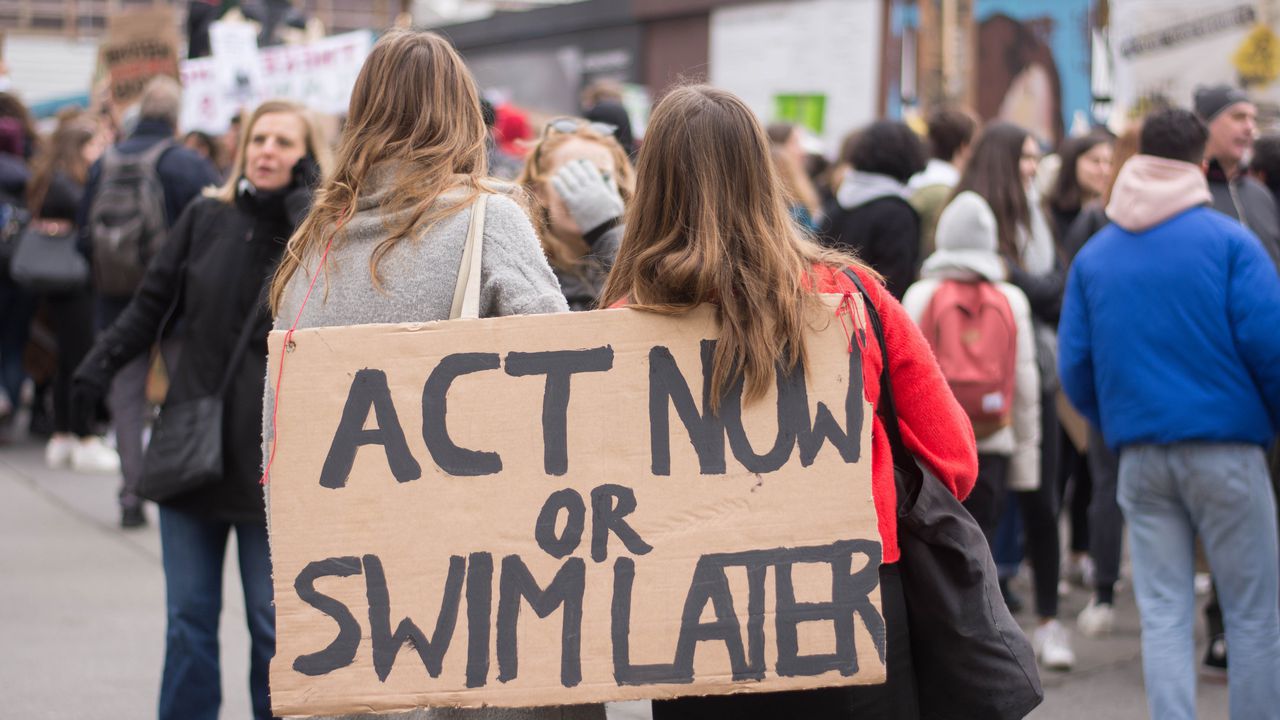
Thousands of students marched on the streets of Brussels on Thursday, demanding action to tackle climate change, under the banner of #YouthforClimate.
A tuna sandwich in the hands of WHO Chief Scientist Jeremy Farrar can tell us more about the limits of global climate and health cooperation than many official statements do. At the 78th World Health Assembly (WHA) in 2025, WHO member states struggled to agree on a consensus position on their draft Global action Plan (GAP) on Climate Change and Health. The negotiations are a window into the complications of international cooperation, entangled problems of the polycrisis, and how isolationism fails to address this.
One year ago, the 77th WHA asked the Director-General “to develop a results-based, needs-oriented and capabilities-driven global WHO plan of action on climate change and health.” From this decision, drafts were created and negotiated between the member states to come to a consensus document for the WHA to discuss and consider adopting. Negotiations toward the GAP went on beyond the time formally allotted for debate and countries continued to negotiate between sessions. Time was running out. The goal of the assembly is to reach consensus, but as the deadline approached, the draft not only faced the possibility of a vote – there were even doubts it would secure the two-thirds majority needed for adoption. When the debate took place, there was still no consensus position reached. Under these conditions, the statements during the debate by WHO member states showed where the fault lines lay.
How the biggest polluters sidestep responsibility
The most prominent voice against the implementation of the draft came from Saudi Arabia and the Eastern Mediterranean Region (EMRO), this year led by Egypt. While there are obvious reasons for a major oil state like Saudi Arabia to delay any policy on the topic of climate change, their statement went in another direction: “Any kind of global plan has to be in line with the principles of the UNFCCC and the Paris agreement: the principles of equity and common but shared and differentiated responsibilities […] we therefore call for a postponement of adoption of this.” Saudi Arabia here opens up the topic of Common But Differentiated Responsibilities (CBDR) or as they put it: “you can’t ask developing countries to pay the price for transformation when they themselves are not responsible for the problems.”
CBDR is a principle in the Paris Agreement recognizing that developed and developing countries have different obligations in addressing climate change, based on differences in both their historical emissions and their capacities. It originates from the UNFCCC (1992) and evolved from the notion of “common concern” in the Convention for the Establishment of an Inter-American Tropical Tuna Commission of 1949. Despite restrictions on fishing, tuna is still on the plate in the fancy building of the Geneva Graduate Institute, which hosted a WHA side event on multilateralism, and thus it found its way into the hands of Jeremey Farrar. The CBDR principle was adapted in the Paris Agreement to balance equity with universal participation, allowing flexible national commitments while requiring wealthier nations to lead on mitigation and finance.
Read more: Climate breakdown threatens food security and health in Iraq
As it happens, the wealthy nations decided not to lead on mitigation but instead to lead against the principle of equity in the WHA negotiations. The United Kingdom and Germany called for the removal of paragraphs containing CBDR language, stating that they already see this as covered by UNFCCC regulations. Australia and Japan also voiced this opinion. This was the major fault line within the negotiations. It is about money, about guilt, responsibility and about defending colonial advantages. Countries that have a history of colonialism also have a history of polluting the atmosphere with greenhouse gases, thus driving climate change. They used the energy from fossil fuels to create an unsustainable standard of living driven by extractivist industries, and simultaneously created underdeveloped and extraverted economies in the Global South. Keeping their old colonies in debt gives them the power to push for more and more extractivism even in their own transitions towards what they see as a green future. However they know the climate crisis will hit them last, as they have more resources for mitigation and adaptation, so these states are defending their “way of life.”
The Global North on track to burn things down
The differentiation in language used by the UK and Germany within UN bodies such as the UNFCCC and WHO creates institutional silos. As a result, systemic links between global issues remain unaddressed. Transferring this fragmented approach to overarching topics like climate mitigation and finance risks eroding multilateralism. The explanations provided by both countries represent a refusal to make the connection between the health of the people and health of the planet. Within this sort of negotiating language we can observe the Global North’s isolationist approach. The most prominent isolationist is the ”America First” US government, so prominent in fact, that they are leaving the WHO altogether. However the US departure just puts more spotlight on the rest of the West that is moving in the same direction.
Isolation is turning a blind eye to the fact that the climate crisis will not stop at borders, will not leave food and health systems intact, and might bring down the financial system of debt that is used as a power tool in negotiations here and elsewhere. Another example of the silo-building inside the UN is that, aside from the UNHCR, no other UN body deals with the problem of climate refugees. With migration being exploited as a major catalyzer of xenophobia during the UK’s Brexit vote and the last election campaign in Germany, the failure to link these issues also reflects isolationist thinking.
The isolationist states do not question fossil fuels, extractivism and the eternal growth paradigm of their economies. The Global North does not want change. Instead, it is on track to burn things.
Read more: People’s Health Tribunal finds Shell and Total Energy guilty of harming African communities
The assignment to the WHO Director-General last year was to draft the GAP to be “coherent with the text of the United Nations Framework Convention on Climate Change and the Paris Agreement.” The Paris Agreement aims to limit warming to 1.5°C above pre-industrial levels, and well under 2°C. As we are already living in a world that was 1.6°C warmer than pre-industrial levels in 2024 (with considerably more warming locked in) and with the IPCC warning that ‘the more is emitted, the less nature can help,’ we have no choice but to plan for a future of at least 3.5°C of warming.
At a warming of this rate, we are likely to see the areas in which 1-3 billion people currently live become uninhabitable. When this happens, where will they go?
If they choose to go to Europe, which is now opposing equity in WHO decisions, it is likely Europe will continue its policy of keeping them away, in order to maintain as much as possible of its current standard of living – the European “way of life.” This is already ongoing through its infamous pushbacks on the EU border implemented by Frontex. Boats are sinking, and people are dying. Jens Spahn, the parliamentary leader of Germany’s largest political party (CDU), has already called for “physical violence” as the solution to migration. With migration likely to reach levels much higher, as predicted above, the mass murder of climate refugees will have to increase. Maybe this is part of the reason why there is such a dramatic increase in military spending in Europe, with “ReArm Europe” emphasizing securing external borders by funding physical barriers and deploying advanced surveillance technologies.
Cancelling debt to clear the way for climate justice
When asked about the warming, Chief Scientist Farrar acknowledged the scenarios of 3°-plus, and suggested that his team is preparing the WHO and taking the coming changes into account. But the limits of the operation of any UN body is defined by the limits imposed by member state decisions.
The decision on the draft Global Action Plan moved to a vote. With zero votes against, 19 abstentions and 109 votes in favor, the draft GPA was adopted. So was it all a bluff? No, the different opinions needed to be voiced, and by abstaining the member states of the EMRO region can now build on their opposition to the cynical tactic of CBDR exclusion. Is it a good thing that the plan was eventually approved? Yes, it will give the WHO the money and the mandate to act. The lack of consensus is also an indication of where there may be levers for civil society to intervene and push for more ambitious action.
The aforementioned debt is one of those levers. Even as CBDR is being attacked it is just the start of what needs to be done. Debt often forces governments and smallholders to sell or lease land to foreign investors, leading to large-scale land grabbing, not only concerning fossil fuels but also the “green tech” future imagined by the west including food security and carbon offsetting dreams. This financial pressure is supported by the International Monetary Fund and incentivizes the exploitation of natural resources – such as forests, minerals, and water – for short-term revenue, undermining environmental sustainability and local livelihoods. These debts need to be cancelled. Germany once benefitted from such a cancellation, following the atrocities the country was responsible for after starting a world war for a second time, including the Holocaust. In 1953, the London Debt Agreement resulted in the cancellation of approximately 50% of West Germany’s external debt, significantly contributing to its post-war economic recovery and the so-called “Wirtschaftswunder” or economic miracle.
Miracles are needed when looking at what a 3°-plus climate will mean for the planet and its inhabitants. As every region is hit differently by the impacts of the climate crisis, cancelling the debt of those communities would give them the freedom to start transformation and preparation to face the impending catastrophe. It would create just a little more justice, and benefit everybody in the long run.
People’s Health Dispatch is a fortnightly bulletin published by the People’s Health Movement and Peoples Dispatch. For more articles and to subscribe to People’s Health Dispatch, click here.