In Gaza, Everyone Around Me Is Starving
From doctors to journalists, and from children to mothers, Israel’s imposed famine spares no one in Gaza.
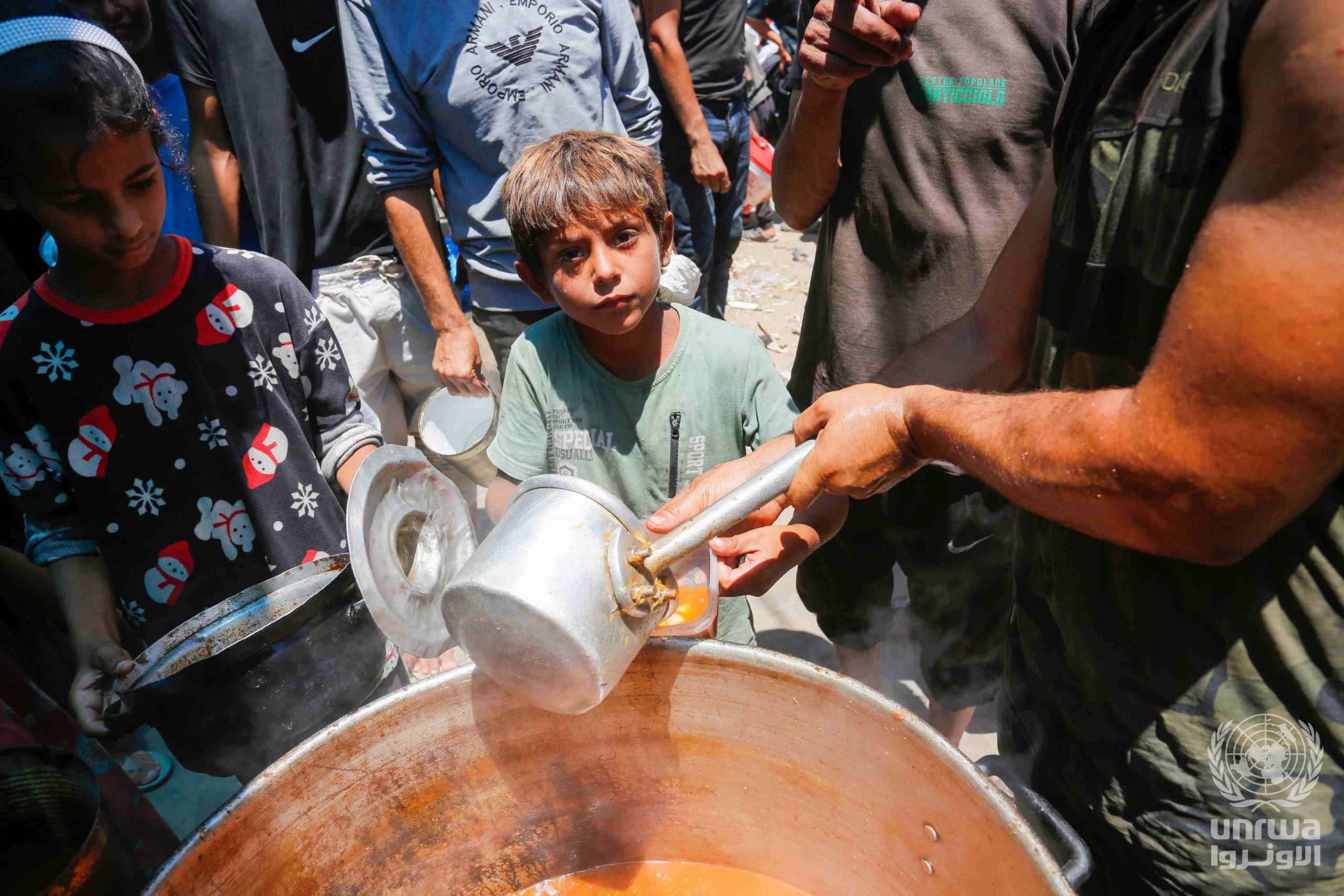
Displaced Palestinians gather to receive food from a charity in Deir el-Balah, Gaza Strip. Photo by Ashraf Amra, June 24, 2024
Two days ago, I had a night shift and received a three-month-old baby girl who weighed one kilogram and was dead. I wrote a death certificate for her.
For five months, the Israeli army has prevented the entry of food and aid into Gaza, significantly worsening the humanitarian situation for the population. The Palestinian Ministry of Health in Gaza reports approximately 110 citizens have died of starvation since the beginning of the famine. The number of deaths in Gaza is increasing in Gaza; markets face a lack of flour and food supplies, and prices are rising. Famine affects all segments of society: doctors, journalists, children, and mothers, each with their own difficult experience with famine.
Ahmed Radhi, 28, from Gaza City, a doctor working at Al-Shifa Medical Center and Al-Ahli Arab Hospital, says:
“We have never witnessed a famine this bad. We are living through very difficult days. We are receiving dozens of citizens in a state of extreme fatigue, weakness, and loss of balance. After examining them, we find very low protein levels and severe malnutrition. The departments in both hospitals are constantly receiving these cases. Two days ago, I had a night shift and received a three-month-old baby girl who weighed one kilogram and was dead. I wrote a death certificate for her. Her father was carrying her in the early hours of the morning and ran to the hospital. She was dead, showing signs of severe malnutrition. We, as doctors at the hospital, work in a 24-hour emergency situation, moving between departments to treat patients, and this requires a great deal of energy and effort. In recent days, we have become unable to work and need to rest more than standing due to the exhaustion and fatigue we are experiencing.”
He adds:
“Yesterday, I was trying to get food to continue working. I couldn’t find anything to buy and was forced to eat falafel without bread. Before the famine, I used to buy bread and some food, and we ate with the doctors, and we were able to continue our work. There was something available in the market for us to buy. I could take something from home with me to eat, but the families there don’t have food, and that’s another struggle. We think about our work, ourselves, and our families. The hungry cases we encounter are very painful. We can’t treat them well. They need nutrients, which are not available in the hospitals because of the closure of the crossings and the prevention of medical supplies and medications from entering. We are in a struggle for survival. Some doctors sleep in the rooms because they are unable to continue working and talking to the patients. We feel constantly out of balance, but we are trying to serve the patients and do our work.”
Ahmed is trying to help his family provide food, but the high prices and scarcity of food have caused the famine his family is experiencing.
Ahmed says:
“I live in the old town of Gaza City. I cannot describe what we are experiencing from the continuous and violent bombing in the town and the targeting of homes with heavy missiles. The famine has become a heavy burden on us. The daily routine is how to secure a loaf of bread. It is difficult to find flour in the market, and even if we do find a kilo for $30, this is difficult. Before the war, the price of a full bag weighing 25 kilos was $10. To get a little bit of vegetables, we need to pay $50 for one kilo. This is why the famine has developed into its most difficult stages, and we cannot live with it. We have begun to lose our ability to work and continue our lives.”
I cannot concentrate on my work. I search daily for flour. We used to crave fruits, vegetables, and meat. Now, I long for a loaf of bread. My life has changed dramatically since the war.
Mahmoud Al-Mashharawi, 26, a journalist from Gaza City who works as a photojournalist, says:
“We are living in difficult living conditions. I struggle to provide food for my family. Every day, we think about what we will eat. We only think about how we will provide food and whether it is available in the market or not. Hunger affects our minds and bodies. Before the war, I weighed 80 kg, but during the war, I weighed less than 60 kg. Signs of hunger are evident on my face and body. I cannot concentrate on my work. I search daily for flour. We used to crave fruits, vegetables, and meat. Now, I long for a loaf of bread. My life has changed dramatically since the war.”
As journalists who work hard to continue their work despite the hunger they feel, he says:
“I often carry the camera and feel off balance and very weak. I stop filming for a while and then continue my work. I used to work continuously without getting tired, producing dozens of videos to cover the war events. Now I no longer have the strength to work. I used to walk several meters to get to work, but I had food and energy to complete my work. Now I no longer have the energy to walk. I think a lot in order to produce a single story. I try to make my work continue and to get the message across. Hunger is a difficult feeling. I am not ashamed to say that I am hungry. I hope that the world will hear us and stop the war on us.”
As a breastfeeding mother, I cannot breastfeed my daughter because I do not have milk. I cannot breastfeed her, and she cries all day from hunger and then gets tired.
Khatam Juma, 30, from Khan Yunis, a mother of four children, including a four-month-old infant, says:
“The famine began with the birth of my daughter, Masa. This is a difficult period for mothers. How will they provide food for their children? I am a breastfeeding mother and I have an infant. My children are under 8 years old. I don’t like the beginning of the day or the arrival of the morning, because I know that my suffering with the words ‘I am hungry’ will begin in the early hours. I need to make bread every day. Our children exhaust their energy due to extreme fear and get hungry quickly. Their father buys a kilo of flour for $30.”
“This kilo produces only nine pieces of bread, which is not enough to satisfy them. I allocate one loaf of bread to each of them, which is not enough, but I am helpless to provide anything else for them. I cook lentils and rice repeatedly every day. Many days I do not feed them bread because I do not have it. As a breastfeeding mother, I cannot breastfeed my daughter because I do not have milk. I cannot breastfeed her, and she cries all day from hunger and then gets tired.”
She adds:
“We used to get milk cartons from the hospital a month ago, but they were completely cut off due to the closure of the crossings. Now we buy milk at a very high price, and I only make it once to last her for several days. We don’t have enough money to buy cartons of milk regularly. My daughter gets very hungry, but I can’t help her with anything because I’m just as hungry as her. I’ve lost more than 15 kilograms. I’ve become very tired. I can’t watch my children like I did before. I search for sleep to escape the hunger and force my children to sleep during the day. My body is very tired, and I see my children’s activity has become very weak. They’ve lost focus, and communicating with them has become difficult. As a mother, is it fair for me to go through this difficult experience? My children are very thin and tired, and I’m very afraid they’ll get sick. I want this famine to end. Famine is more difficult than bombing. In bombing, we die and rest, but in famine, we suffer slowly, and no one cares. I ask the world to save our children.”
Reham Brika, 27 years old, from Khan Yunis, mother of a two-year-old girl who is seven months pregnant, says:
“As a mother, I am suffering with my baby girl whom I care for and the baby girl in my womb. I need to feed my daughter Sham, who is delayed in growth due to hunger. She does not know many types of food, and when she sees her on the phone, she asks me about them. She often asks me for bread throughout the day, and we try to provide it for her, but she wants something with her bread. She craves tomatoes and cucumbers, but their prices are high, and we cannot buy them because we do not have the money. As a pregnant woman, I need food for the fetus’s growth. I have a great fear of giving birth to my baby in a difficult health condition, because for five months I have had very little food. I eat only one meal a day. When I go to the hospital for a follow-up of the pregnancy, I see many cases of newborns in very poor health. I wait for the crossing to open so that any type of food can enter so that I can eat for the safety of my fetus. This period is the most difficult in my life. I do not live in normal pregnancy conditions. I am hungry, extremely exhausted, and tired. I have another baby girl who needs my attention and care. But I am unable to do so because of hunger. Starvation is a very humiliating and bad feeling.”
As a pregnant woman, I need food for the fetus’s growth. I have a great fear of giving birth to my baby in a difficult health condition, because for five months I have had very little food. I eat only one meal a day.
I cannot describe the feeling of hunger. It is a feeling that diminishes a person’s value. I often think about how people live outside, and how far their lives have come while we live in difficult and impossible war conditions. I never expected that one day I would feel hungry for days on end, or that I would think daily about what I would eat.
I fear greatly for my mother, who underwent surgery two weeks ago and whose wound has yet to heal. She needs food and good nutrition to recover from the operation, which she underwent under difficult circumstances. I look at my brother, who works for an international organization in a hospital. His shift lasts 24 hours a day and he feels hungry and finds nothing to eat. Our lives have become focused on providing food.
We used to have agricultural land in Gaza, but the Israeli army completely destroyed it and prevented fishermen from entering the sea and fishing to save us from hunger. They closed the crossings and did not allow food to enter. Unfortunately, I have become a tired girl who cannot talk much. I cannot work for long. I just want to sleep or remain silent. I am tired of hunger and, unfortunately, I cannot continue.