The Workforce Powering America 250 Demands Better Pay and Conditions
Every year, tens of millions of people descend on Philadelphia to walk the streets that helped launch a nation. Philadelphia is a city of “firsts” and “oldests” from the cobblestone streets of Elfreth’s Alley, to the first lending library and first public hospital. The region drew a record-breaking 46 million visitors in 2019 alone to […]
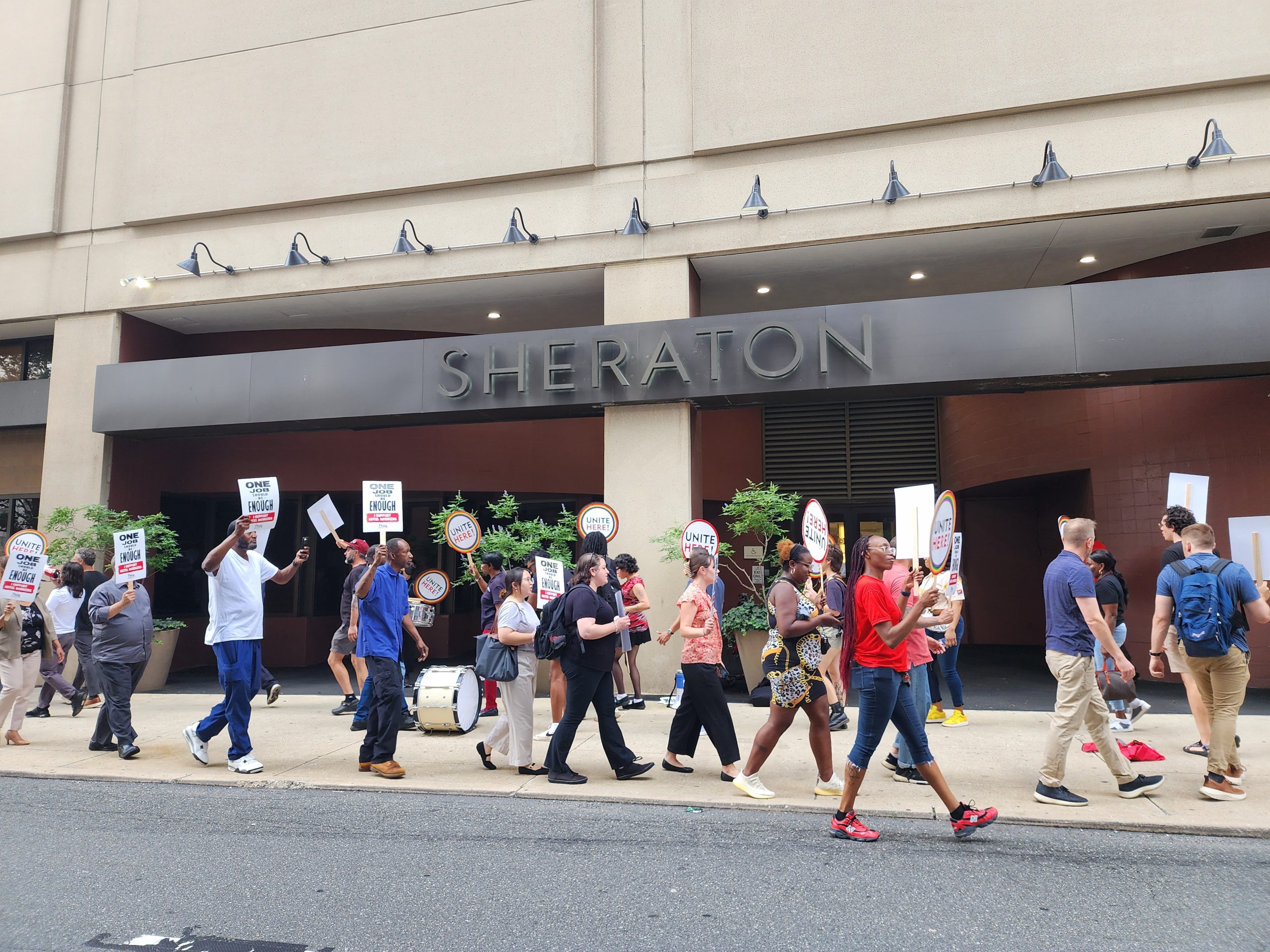
On July 23, hotel workers rallied in front of the Sheraton Philadelphia Downtown, demanding better working conditions, benefits, and higher pay. Photo by Kristine Villanueva
Every year, tens of millions of people descend on Philadelphia to walk the streets that helped launch a nation. Philadelphia is a city of “firsts” and “oldests” from the cobblestone streets of Elfreth’s Alley, to the first lending library and first public hospital.
The region drew a record-breaking 46 million visitors in 2019 alone to take in the historic sights — and is expected to host even more tourists for America’s 250th anniversary next year. But while some residents and visitors focus on festivities, workers who remain the backbone of the city’s tourism industry, are stepping out from behind the scenes with their own demands.
“When I first started, we were like a well oiled machine,” said Monica Berks, who has worked at the Wyndham Hotel in Center City, Philadelphia, as a restaurant server, bartender and in banquets for seventeen years. “Now everyone is stressed out. You’re doing your job and someone else’s job that’s not there.”
Berks explained the invisible labor that goes into setting up a buffet. Coordinating with the kitchen, interacting with guests, ensuring restrictions can be accommodated, as well as other guest needs, can all add up when it’s a single worker’s job to ensure the operation runs smoothly. Cashiers are also waiters, bussers, and hosts, Berks explained.
“You were doing four or five jobs that were out of our wheelhouse,” she added. “It’s really been bad. Some people come in and work and get frustrated and quit. We had two girls quit in a matter of months who never got replaced.”
Hotel workers in the city say stories like Berks’ are the norm. They’ve been stretched thin since the start of the COVID-19 pandemic in 2020. At a picket in July outside the Sheraton Philadelphia Downtown, workers say just 150 employees now maintain the 700-room hotel.
When I first started, we were like a well oiled machine. Now everyone is stressed out. You’re doing your job and someone else’s job that’s not there.
The hospitality sector isn’t just bracing for high occupancy but for peak saturation. Even if only a fraction of the visitors stay overnight, the hotel workforce must scale up to meet intense demand. Next year, Philadelphia will also host major sporting events including the FIFA World Cup and the MLB All-Star Game.
UNITE HERE Local 274 says that the region could see $1 billion in revenue through these events. Unionized workers in eight hotels seek increased pay, better working conditions, improved healthcare and pensions as the hospitality industry takes on what Councilmember Isiah Thomas described as “tourism on steroids.”
“We’re a big city. They need to pay us like a big city,” said Jèan Guenther, a laundry attendant who also performs houseman duties such as keeping hotel rooms and common areas clean, and restocking amenities at the Hilton Garden Inn.
Philadelphia has a big city tourism budget, committing almost $100 million from its General, Transportation, and Capital funds to support preparations for large-scale special events planned. There’s also an additional $500 million for capital investments at Philadelphia International Airport to “further accommodate an influx of visitors.”
The Sheraton Philadelphia Downtown and the Hampton Inn Center City recently wrapped their first-ever strike and workers at the Wyndham Philadelphia Historic District just voted to authorize a strike, too, with more hotels pending to authorize their own.
Local 274 is calling for a $30/hour wage floor within three years, echoing concerns of rising living costs and major transportation cuts that make commuting to work more difficult for hospitality staff.
We need more workers striking and disrupting business as usual to stop the billionaire takeover of our country.
Cities preparing for major sporting and cultural events have seen hotel workers push for higher pay and better benefits, echoing the demands of Local 274 in Philadelphia. Earlier this week, hotel workers in Los Angeles now have a $30/hour wage floor in anticipation of the summer Olympics in 2028.
“The workers at the Sheraton and the Hampton [who] led the way are inspiring other hotel workers to stand up and fight,” said chapter president Rosslyn Wuchinich. “We need more workers striking and disrupting business as usual to stop the billionaire takeover of our country.”
Even with the money to back the tourism boom, the workforce to accommodate visitors remains a skeleton crew in many hotels.
A report from the American Hotel and Lodging Association, a U.S. trade group that does market research on the hospitality industry, says that staffing remains well below pre-COVID levels, with employee retention and high turnover rate chief among reasons why many hotels across the nation, including those in Philadelphia, remain understaffed.
As Philadelphia gears up for its Semiquincentennial celebrations and major sporting events, the city’s hotel workers are staking a claim not just for higher pay, but for recognition of the work that keeps the city running.
“[We want] Respect for the workers. Because as it stands now, the management does not respect us like we should. The amount of work we do. They don’t realize until they have to do the job how serious or how hard it is to do it,” Berks said.