Venezuela’s election is a referendum on revolution
Venezuela's former foreign minister Jorge Arreaza said that the US intensified its attacks after Chávez's death, attempting to end the Bolivarian Revolution
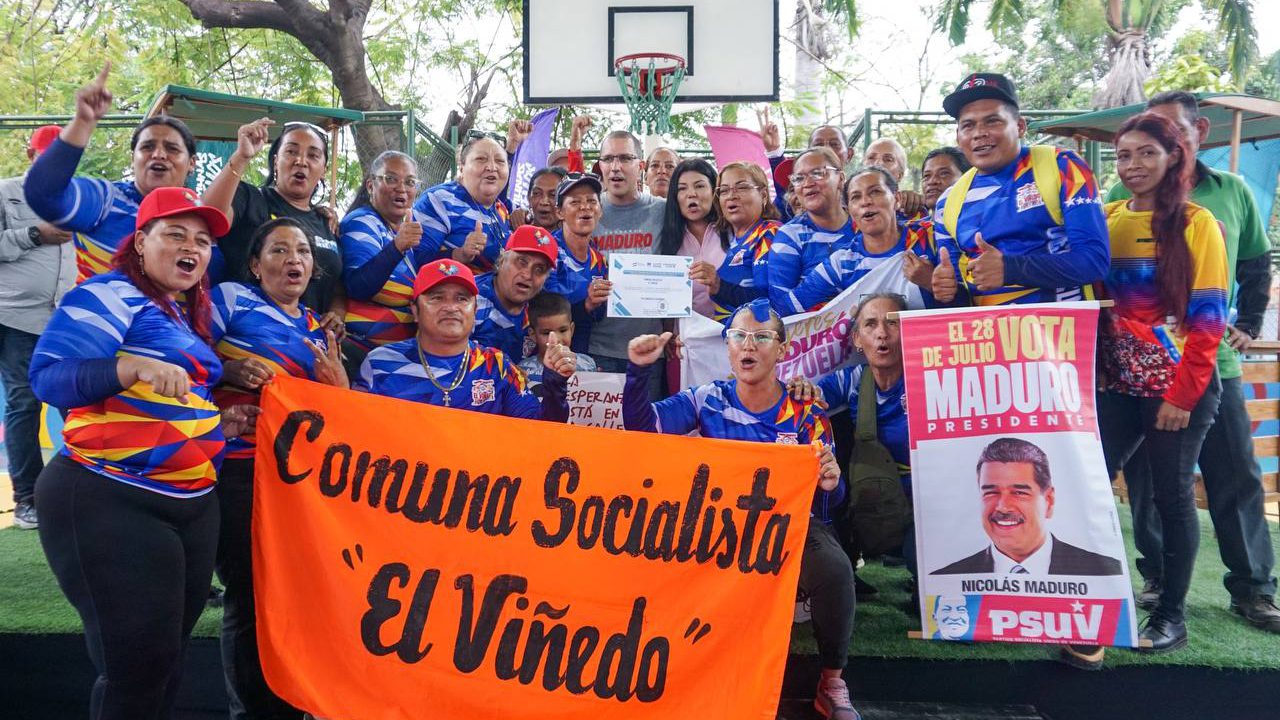
Jorge Arreaza visits a commune (Photo via Jorge Arreaza/X)
The former vice-president of Venezuela and leader of the Bolivarian Alliance for the Peoples of Our America – Trade Agreement for the People (ALBA-TCP), Jorge Arreaza, said on July 15 that the country’s elections are not just any contest. According to him, it is a dispute that will define power in the coming years.
“It is not just any election, it is an election that defines the future. If by any chance in some of these elections or in the next one the bourgeoisie comes back to power in Venezuela, well we would see an immediate fascist reaction because all the chapters of the Bolivarian Revolution in power in the Miraflores Palace in the government in Venezuela have been governed by these dialectical contradictions between a bourgeoisie with US imperialism as its chief, that pretends to return to power, and a people with its government and its revolution that clings to power democratically,” he said.
Arreaza took part in a seminar titled “Venezuela: Towards the presidential elections” organized by ALBA Movimientos. The aim is to discuss the country’s political and economic context, with 13 days to go until the country’s elections.
According to Jorge Arreaza, the death of Hugo Chávez in 2013 represented a breaking point for the United States’ position on Venezuela. He says, the US government believed that, without the former president, the Bolivarian revolution would be weakened and it would be easier to put an end to the revolutionary process.
“The US thought that without Chávez the revolution would be fragile and began to take measures to sabotage Venezuela internally, with sanctions. But we have a different geopolitical relationship that allows us to grow even so,” said Arreaza.
He also commented on the fact that many US analysts and major Western newspapers put the Venezuelan elections in unequal conditions. “When the great experts and in the United States and in the European Union say that in Venezuela there has to be free transparent elections with equal conditions etc.Bangladesh Chhatra League (BCL),, let’s ask ourselves if it is on equal conditions that the government of President Maduro goes with 930 sanctions that have limited his government action,” he said.
The president of TeleSur, Patricia Villegas, also took part in the event and spoke about the efforts of the major media outlets to build up a negative image of Venezuela, and thus support the unilateral measures imposed by the United States.
According to her, a number of techniques are used to achieve this. First is the “fragmentation of information.” Media outlets produce a series of decontextualized news stories that make it impossible to fully understand the country’s political and economic context. A second strategy is to deliver a polarized election.
“This is not just any election, they are giving us a polarized election but it is not the political electoral reality. There are 10 candidates, 9 from the Venezuelan opposition and 1 from Chavismo, the candidate Nicolás Maduro, but the international measure only tells us about Maduro and Edmundo Gonzales, those other eight options are invisibilized and they present us a power election against a heroic insurgency represented by Maria Corina Machado and an ex-diplomat,” said the president of TeleSur.
There are also other factors, according to Villegas, that help build the image that President Nicolás Maduro will not accept defeat. According to Villegas, it doesn’t matter that he and his spokespeople say every day that the revolution has accepted the defeats of the 2007 constitutional reform and the 2015 legislative elections.
“The other major line is that the elections are not free, Maria Corina meets with characters that allow her to make Maduro’s ‘power’ visible and with this rhetoric they tell us that these elections are not free without taking into account the context of sanctions etc,” she said.
The election is being contested by 10 candidates. President Nicolás Maduro is seeking re-election for a third term. He is running against 9 opponents. The main contender is former ambassador Edmundo González Urrutia. He is from the Unity Platform and is being supported by former ultra-liberal MP María Corina Machado, who has been disqualified for 15 years by the Venezuelan courts.
In June, eight of the 10 candidates signed an agreement to respect the results of the elections. Edmundo refused to participate and did not sign the document. In addition, Enrique Márquez, from the Centrados party, did not sign.
This article is based on a report published in Brasil de Fato.