AMLO and his eternal struggle to refound Mexico
In this piece, we talk about AMLO's two subsequent presidential elections and the formation of Morena, the political party that brought the progressive politician to power.
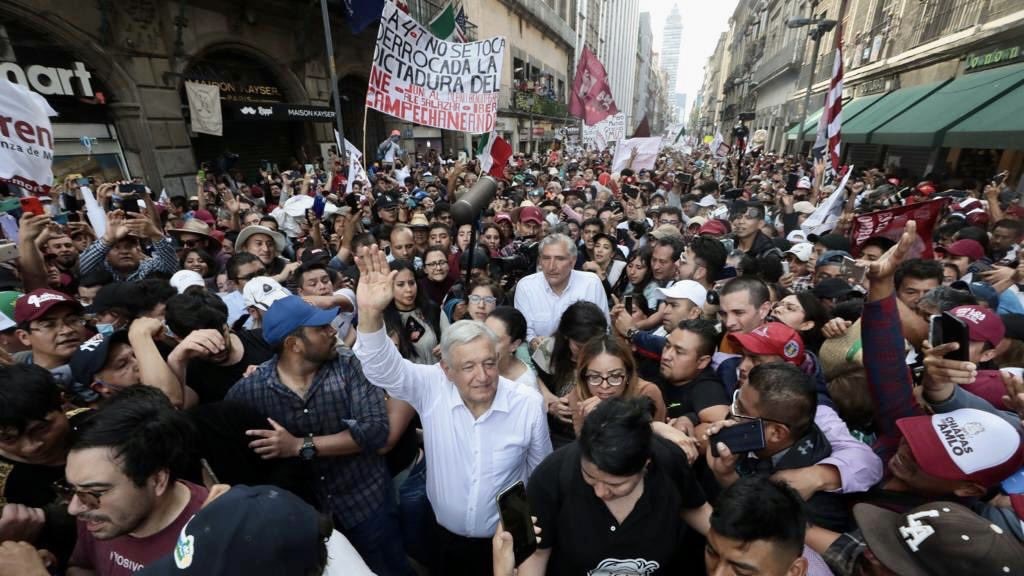
Mexican President Andrés Manuel López Obrador walks among thousands of supporters to mark the four years of the 4T in 2022. Photo: MORENA
This piece is part two in a series about former Mexican President Andrés Manuel López Obrador (AMLO) who finished his term in office on September 30, 2024. AMLO made history by leaving office with a record 80% approval rating largely attributed to his efforts of poverty reduction and wealth redistribution. Part one of the series reflects on his beginnings in politics and part two is on his struggle against corruption and dirty politics on the road to the presidency.
After the defeat in the 2006 elections, AMLO realized that the road to the presidency was going to be much more complicated. On the one hand, he had to face the internal discussions within the PRD, while on the other hand, he continued his political activity against President Felipe Calderon.
In 2008 the PRD, the party he co-founded, held primary elections to elect a new group to lead the center-left formation. The organization soon began to show signs of splintering as the two strongest wings of the party began to accuse each other of fraud.
That same year AMLO publicly denounced that President Calderón was seeking to privatize PEMEX, Mexico’s state-owned oil company. In fact, on October 23 the Mexican Senate approved the oil reform, which allowed private companies to invest in the company and gave it autonomy over its budget. AMLO called on his supporters to take over the Senate in protest.
The foundation of MORENA and the 2012 elections
The disagreements within the PRD led AMLO and his closest supporters to found on October 2, 2011, the political group MORENA (National Regeneration Movement), which aimed to unite around his leadership more social movements, citizen collectives, and civil associations in his quest for the Mexican presidency. One of his most ambitious projects was the creation of the Committees for the Defense of the Vote, which sought to more rigorously monitor the electoral processes and thus avoid fraud by the right-wing parties.
Nevertheless, AMLO decided not to leave the PRD for the presidential elections, among other things, because he received the support of the other possible candidates for the presidential elections, Marcelo Ebrard. In addition, the leftist and class-conscious Labor Party (Partido del Trabajo) and the Citizen’s Movement (Movimiento Ciudadano) supported AMLO’s candidacy under the Progressive Movement alliance. The main objective of the Progressive Movement was to create an alternative political project to the neoliberal hegemony that had dominated Mexico since the end of the 20th century.
The presidential elections were contested by several candidates, including Enrique Peña Nieto (PRI), AMLO (“Progressive Movement”), Josefina Vázquez (PAN) and Gabriel Quadri de la Torre (PANAL). According to electoral authorities, Peña Nieta triumphed in the elections with 39.17% of the votes, which meant the return of the PRI to the Executive after two consecutive periods of PAN governments. AMLO obtained 32.41% of the votes, while Vázquez obtained 26%.
Again, the progressive candidate said that there were serious irregularities in the elections, specifically vote buying by the PRI. According to AMLO, Peña Nieto and his team allegedly offered thousands of people Soriana supermarket cards in exchange for voting for his party. Days later, there was a massive influx of people to said supermarket; however, no serious investigation was undertaken to determine if this accusation was true.
Third time’s the charm
The fact that AMLO decided to participate in a third presidential election suggests that he was sure that he had been robbed of the presidency twice, so he only needed to improve the strategy to achieve his desired electoral goal finally. To this end, he got the National Electoral Institute to grant MORENA the status of a national party, allowing it to participate in the 2018 presidential elections.
It could be said that behind this decision is the political reading that saw in his popular figure the possibility of founding a movement around a single person. The presidential candidate warned that this would be the last time he would contend for the presidential chair.
Despite his historic militancy in the PRD, AMLO rejected any possibility of an alliance with that party (in the end, the PRD supported the candidacy of Anaya, an avowed right-winger). AMLO formed an alliance called Juntos Haremos Historia (Together We Will Make History), between MORENA, the PT, and the Social Encounter Party (PES). His government project was based on the strengthening of the state to guarantee a better distribution of wealth and greater control over the large companies that have obtained enormous profits from Mexico’s natural resources for centuries. His opponents again branded him as populist and anti-democratic and expected that once again the usual mechanisms would prevent AMLO from winning the elections. But this time it was different because it was impossible to hide AMLO’s enormous support compared to the other candidates.
The elections were held on July 1, 2018 and AMLO won in a landslide victory over his opponents. He obtained 53.19% of all votes, followed by Ricardo Anaya Cortes of the PAN (22.27%) and José Antonio Meade Kuribreña of the PRI (16.40%).
Before thousands of supporters, after learning the results, the new Mexican president said “The transformation that we will carry out will consist, basically, in banishing corruption from our country. We will have no problem in achieving this purpose because the Mexican people are heirs of great civilizations and, therefore, are intelligent, honest, and hard-working. Corruption is not a cultural phenomenon but the result of a decadent political regime. We are certain that this evil is the main cause of the social and economic inequality and violence we suffer. Consequently, eradicating corruption and impunity will be the main mission of the new government… I reiterate my commitment not to betray the trust placed in me by millions of Mexicans. I will govern with rectitude and justice. I will not fail you because I uphold ideals and principles, which is what I consider most important in my life. But I also confess that I have a legitimate ambition: I want to go down in history as a good President of Mexico. I wish with all my soul to raise the greatness of our country, to help build a better society, and to achieve the happiness and joy of all Mexicans.”
Many saw in AMLO’s triumph a historic force that had been contained and repressed for decades in Mexico through electoral fraud, vote buying, and the widespread corruption of public institutions. Others saw this triumph as the only way to confront the Mexican oligarchy that had plundered the nation for centuries. Still, others saw in his victory the risk of Mexican institutions becoming autocratic.
The truth is that at last, it seemed that Mexico was betting on a democratically elected alternative that would not be aborted by the state institutions themselves. MORENA and AMLO would have the enormous challenge of satisfying the great expectations that more than half of the Mexican voters placed in them, knowing that a disappointment would have meant the setback of decades of social and political struggle in the country.