More than 3,400 Venezuelans have returned to the country since the beginning of the Trump administration
New wave of migrants arrived in Venezuela this Friday (2) with 172 people
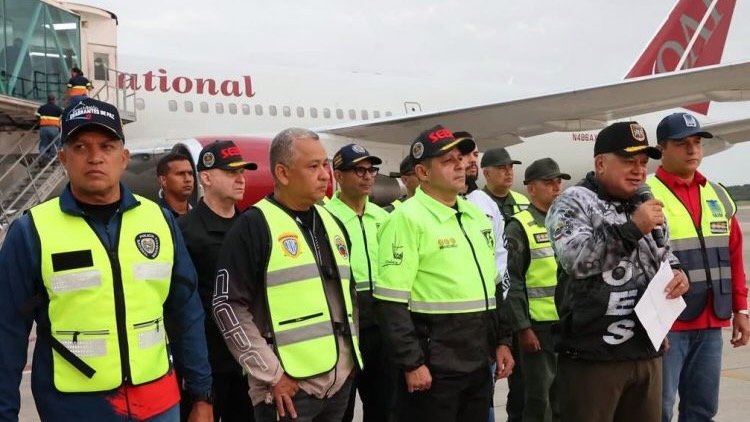
Flights of returned Venezuelan migrants are repatriated through the "Return to Homeland" program. Photo: BdF
US President Donald Trump took office on January 20 and began a massive deportation process of migrants living in the US. One of the countries most affected was Venezuela. In just over 3 months, 3,472 Venezuelans were deported as a result of Trump’s policies. In total, more than 139,000 people have been deported from the United States.
The last batch of Venezuelans arrived this Friday, May 2. A flight from the Venezuelan state-owned company Conviasa brought 172 people. The next plane will arrive in the early afternoon with another 200 citizens, raising the number of Venezuelans deported since the beginning of the Trump administration to 3,672.
In addition to the deportees who returned to Venezuela, another group of 252 Venezuelans were arrested and sent to the maximum security prison in El Salvador, the Terrorism Confinement Center (CECOT). They are accused of being part of the criminal group Tren de Aragua. The US government, however, has not presented any evidence to support this.
Although the deportation policy was promoted by the White House, Caracas is helping Venezuelans return to the country. The government has widely promoted repatriation under the Return to the Homeland program, which began in 2023. The goal of Nicolás Maduro’s government is to offer logistical support to Venezuelans abroad who wish to return but may be in a vulnerable situation.
One of those responsible for receiving and managing the reintegration of deportees in Venezuela is the Minister of the Interior, Diosdado Cabello. This Friday, May 2, in addition to celebrating the return of migrants, he reinforced that the government’s plan is to bring back as many Venezuelans as possible so that they can once again “be close to their families.”
“It is an extraordinary effort, a coordinated effort, a team effort, but it also has to do with the instruction given by the president to bring Venezuelans back, wherever they are. It is unlikely that there will be an operation similar to the one we are carrying out in Venezuela,” he said.
Trump and justice
Texas federal judge Fernando Rodriguez Jr. has barred Trump from using the Alien Enemies Act of 1798 to deport Venezuelans. The law states that anyone in the United States who is considered to be a member of a terrorist organization is subject to deportation as an “enemy alien.” Such citizens, however, must be over the age of 14 and cannot be naturalized or permanent residents of the United States.
Rodriguez said in his ruling that Trump’s measure is not legal because the country is not facing a foreign threat posed by the Aragua Train group. In his ruling, the judge permanently prohibits expulsions based on this law.
“Neither the Court nor the parties dispute that the Executive Branch may order the detention and removal of aliens engaged in criminal activity in the United States. However, the President’s invocation of the Accessible Customs Appeals Act through the Proclamation exceeds the scope of the statute and is contrary to the common sense of its terms,” says the judge who was appointed by Trump himself in 2018.
The judge also ordered Temporary Protected Status (TPS) to be maintained for Venezuelans living in the US. The measure guaranteed that Venezuelan migrants could live and work in the country until October 2026. Trump had overturned this measure, which could affect more than 600,000 people who were now at risk of deportation.
In response to Rodriguez’s move, Trump filed a petition with the Supreme Court asking to repeal TPS and uphold the Alien Enemies Act. Vice President JD Vance said the White House would appeal any ruling that limits Trump’s ability to carry out deportations.
“We are aggressively appealing this. We believe that the highest courts of appeals, and in particular the Supreme Court, will recognize that immigration enforcement is an essential function of the president of the United States. If you tell the president he is not allowed to deport criminal illegal immigrants, then you are telling the president he is not allowed to be president. We reject that,” he said in an interview with Fox News.
Trump had already faced a similar ruling. Federal Judge James Boasberg in Columbia blocked the law in early March, but the president overrode the ruling and sent the 252 Venezuelans to El Salvador. At the time, even after sending the deportees to CECOT, the Trump administration filed a motion to challenge the ruling, but a federal appeals court rejected the government’s request.
Round trips
After disagreements temporarily interrupted the flow of migrants returning, Caracas began receiving Venezuelans deported from the United States again in March. The decision was only made after an agreement between the governments signed by Maduro and the US special envoy, Richard Grenell.
The decision comes in the wake of a disagreement between Caracas and Washington. The two governments had announced an agreement on deportations in early February. At the time, Grenell had traveled to Venezuela to meet with President Nicolás Maduro. The Venezuelan government agreed not only to receive the flights, but also to pick up the migrants with a plane from the state-owned airline Conviasa. The US envoy even stated that the Trump administration does not want a “regime change” for Venezuela.
In March, however, the White House announced that it would not renew the license that allowed the US oil company Chevron to operate in Venezuela. In response, the Venezuelan government said it would no longer receive deportees. After this exchange of statements, the two governments reached an agreement to resume the deportation of Venezuelans.
First published on Brasil de Fato.