Terrorist attack on church kills 27 worshipers in Damascus, Syria
The HTS-led Syrian interim government accused ISIS of carrying out the suicide bombing, raising doubts about its ability to maintain stability and restrain sectarian violence in the country.
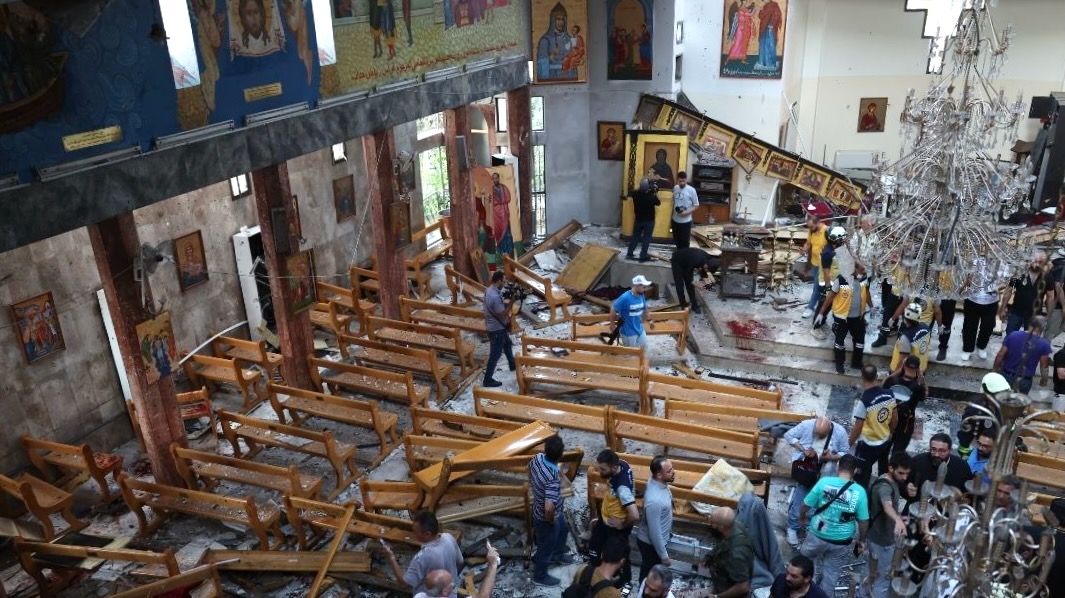
Christian church, Greek Orthodox Mar Elias, in Damascus after terrorist attack. Photo: UNOCHA
At least 27 people were killed and several others wounded in a terrorist attack that targeted the Greek Orthodox Mar Elias Church, in the Syrian capital Damascus on Sunday, June 22.
According to the Syrian Interior Ministry, the attack was carried out by a suicide bomber affiliated with the Islamic State of Iraq and Syria (ISIS), a terrorist group that has been active in different parts of West Asia for over a decade, including in Syria.
The ministry said in a statement issued on Sunday that the attacker entered the church and opened fire on worshipers, before detonating himself with an explosive vest.
The ministry’ spokesperson, Noureddine al-Baba, stated during a press conference on Tuesday, June 24 that Syrian security units in Rural Damascus carried out an operation, targeting hideouts of a terrorist sleeper cell linked to ISIS that planned the bombing of the church.
The spokesperson reported that the authorities arrested the members of the cell, and confiscated all the explosives and weapons in their possession. The investigation has so far revealed that the cell is led by a Syrian national, whose confessions were videotaped and might be released later, after the authorities conclude his interrogation.
The ministry spokesperson also announced that another planned terrorist attack that aimed to target the Shiite shrine of al-Sayyida Zeinab in Rural Damascus was thwarted, after another suicide bomber of the same cell was arrested, while he was on his way to carry out the attack.
The Syrian official clarified that the terrorist who attacked the church and the other who was captured prior to blowing up the Shiite shrine are not Syrians.
He further explained that both of them received the needed assistance by the cell’s leader to infiltrate Damascus, after the fall of former Syrian President Bashar al-Assad last December, as the country experienced a “security vacuum”.
Sectarian violence: the biggest challenge for Syria’s interim government
The bombing of Mar Elias Church brought back to the forefront one of the biggest dilemmas that has been facing Syria’s interim government, which is mainly led by former leaders and members of Hay’at Tahrir al-Sham (HTS).
The HTS has been designated by the United States as a Foreign Terrorist Organization (FTO) since 2014. After former HTS leader Ahmad al-Shara’a assumed power as the country’s interim president, the USD 10 million bounty issued by the US for the arrest of al-Shara’a, was lifted. However, the organization has not been removed from the FTO list yet.
Moreover, the HTS is perceived by religious minorities in Syria as an extremist group that poses a major threat to the historic interfaith coexistence in the country.
A number of deadly clashes between the HTS-led government and some religious sects across the country during its half-year rule, have further deepened the fears of these minority groups.
Al-Shara’a (also known by his nom de guerre as Abu Mohammad Al-Julani) has made strenuous efforts to recreate his image and that of his entourage, presenting a more moderate model of Islam.
However, the continued sectarian violence in the country has made building trust between the new government and religious minorities unattainable in the short-term.
The history of al-Shara’a as a former militant, who for many years led extremist groups and had ties with others, including ISIS, may also be contributing to the doubts that these minorities have about his government’s ability to achieve civil peace.