Hong Kong’s return is part of a much larger struggle that isn’t over yet, says Chinese researcher
Since Tuesday, July 1, China and its Hong Kong Administrative Region have been holding celebrations for the 28th anniversary of the island's return to the Asian giant.
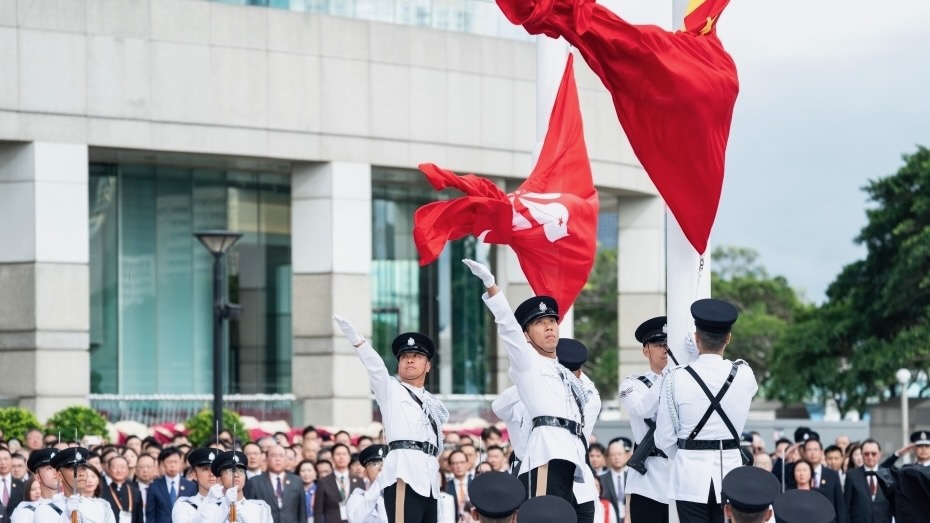
Hong Kong Special Administrative Region government holds flag-raising ceremony to celebrate the 28th anniversary of Hong Kong's Return to the Motherland on July 1. Photo: Peoples Daily
“I think that we can’t underestimate the significance of Hong Kong’s return to China 28 years ago,” says Tings Chak, Asia coordinator for Tricontinental: Institute for Social Research and editor of Wenhua Zongheng International.
“It wasn’t just about transferring administrative control. It was part of a much larger and unfinished struggle, this long historical effort to liberate a country from the vestiges of colonialism to reunify people and to fully restore territorial and political sovereignty,” explains the researcher, who was born in Hong Kong.
Beginning on July 1, China and its Hong Kong Administrative Region held celebrations for the 28th anniversary of the island’s return to the Asian giant. On Thursday, July 3, the Shandong, the first all-Chinese aircraft carrier, arrived in Hong Kong as part of the celebrations that continued until July 7.
Tings argues that the consequences of a long period of colonization take time to overcome, and that this is not just the case in China.
“We know that the end of formal colonial rules are only the beginning of a much harder and longer process. Because the real work, the deeper liberation comes after,” she reflects.
“How do people who were divided by colonialism, who were subject to a different political and economic system, a different language, a different culture, on the one hand, and people who experienced a socialist revolution, on the other, come together again?” she asks.
“This isn’t something that happened in 10 or 20 years or even 28 years. It takes time. It takes generations.“
The interference lingers
Hong Kong not only suffers the consequences of a past intervention, it continues to be the target of interference today.
“Especially younger generations have grown up without really any understanding of China’s modern history, China’s socialist revolution or how the communist party of China works and what are the real advances and material gains for the people of a country that was so poor, not so long ago,” Tings explains.
“And that’s not accidental, you know, colonialism left deep ideological and institutional legacies, and in many ways is still being preserved, especially as we see them in this phase of the new cold war that is imposed on China by the US led-West,” she criticizes.
In 2019, a series of anti-China protests were carried out in Hong Kong. Later investigations revealed that the protests were supported by the US.
The Chinese government produced the “Factsheet on US Interference in Hong Kong Affairs and Support for Anti-China and Disruptive Forces in Hong Kong“, in which it denounced five types of actions promoted by the US, including strategies like the approval of interventionist regulations such as the Hong Kong Human Rights and Democracy Act, promoted by then Republican Senator Marco Rubio, now secretary of state in the second Trump administration.
The list includes trade and other types of sanctions on the island’s officials, as well as public encouragement of anti-China actions, such as a speech on June 19, 2019, by then-Speaker of the US House Nancy Pelosi at The Christian Science Monitor, where she praised actions that violate Chinese laws.
“For those of us who come from countries in the Global South, I think we understand this deeply; many of our societies have endured centuries of colonial domination, humiliation and division, and declarations of independence have not ended that,” Tings highlighted.
The future
Tings believes that more young people like her need to have the opportunity to understand more about the Global South and the entire process in China, “to understand how historic China’s achievements under socialism have been, from the eradication of poverty to the transformation of our people’s material conditions under the leadership of the Communist Party.”
Among other works, Tings is the author of Serving the People: Eradicating Extreme Poverty in China, a survey that shows the political and social process of lifting 98.99 million people out of extreme poverty from 2013 to 2021.
“I hope that younger Hong Kongers will have the opportunity to experience similar processes and get directly involved to see for themselves, and to be part of the country in a long historical sense,” says Tings.
Reunification: Hong Kong’s historic return to China after 156 years
At midnight on July 1, 1997, the Military Band of the People’s Liberation Army (PLA) of China played the anthem of the People’s Republic of China at the Hong Kong Convention and Exhibition Center. The flag of the People’s Republic of China and the flag of the Hong Kong Special Administrative Region were flown together.
The feat marked the end of 156 years of British rule over the Chinese island. Hong Kong, along with Taiwan and Macau, are a significant part of what China considers the “Century of Humiliation”, the period when the country suffered invasions, the loss of territories, and huge massacres at the hands of colonial powers.
The period stretches from 1839 (with the imposition of the first Opium War by the British) until the founding of the People’s Republic of China.
Negotiations for the return began in 1982, with a visit by British Prime Minister Margaret Thatcher to China.
There were 22 rounds of negotiations ending in December 1984, when the governments agreed that China would resume sovereignty over Hong Kong on July 1, 1997.
This article was first published by Brasil de Fato in Portuguese.