US envoy says disarmament issue is a “Lebanese problem”
US envoy Thomas Barrack stated that “Lebanese Armed Forces (LAF) is the perfect place. We have to bolster it. We have to enhance it. We have to give it resources.”
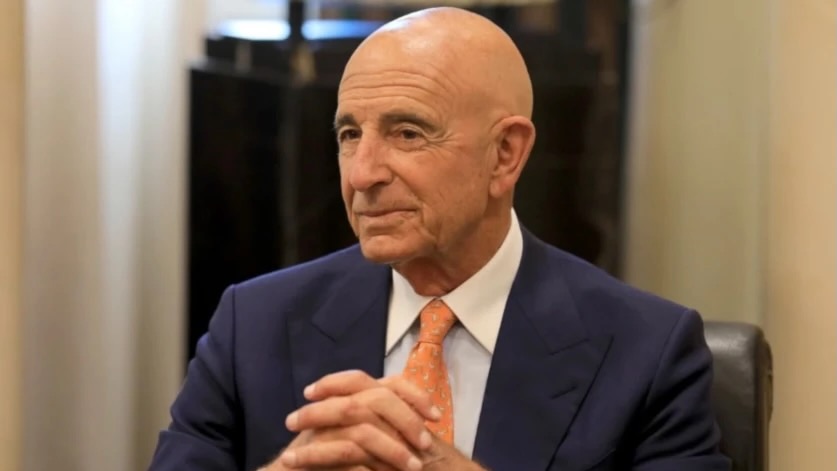
US envoy for Syria Thomas Barrack. Photo: al-akhbar
US envoy for Syria Thomas Barrack said that the Hezbollah disarmament issue is “a Lebanese problem”, referring to Hezbollah as both a “political” and a “terrorist” party.
In an interview with LBCI, Barrack reiterated that the US is “ready to usher, help, influence, and act as an intermediary”, should Hezbollah’s political party choose to turn in its weapons.
Barrack then addressed reports of a proposed timeline for the disarmament. “The press is making that up. I never said anything about [that],” he noted.
Asked whether the current status quo could persist until next year’s parliamentary elections, he replied, “absolutely not”, maintaining that “nobody is going to stick around doing this until next May. I have a boss [US President Donald Trump] who has amazing courage, amazing focus. What he does not have is patience. So if Lebanon wants to just keep kicking this can down the road, they can, but we are not going to be here in May having this discussion.”
Reacting to the Hezbollah chief’s recent statement that the resistance will never surrender its weapons, he remarked, “typical Lebanese negotiation. It is a negotiation until everybody is ready to really make a deal.” He added: “We have to create a timeframe. And by we, I mean the Lebanese. We will help define the boundaries and borders.” He underscored that the US is ready to help with the process, but not influence it.
US President Donald Trump has amazing courage, amazing focus. What he does not have is patience.
When asked whether he trusted Lebanese politicians, Barrack refrained from answering. “I cannot answer that question. I am encouraged by what their reaction has been. I am also smart enough to understand that they are playing backgammon and I am playing chess. … They have to decide their dedication and commitment. We are giving them an opportunity to do that, one by one.”
He then acknowledged the widespread fear of renewed violence, saying “Everybody’s scared to death. Nobody wants a civil war. Nobody wants to push too hard. You have a confessional system that requires unanimity. This is a dialogue, this is not an event.”
On reconstruction, Barrack affirmed that Gulf states are committed to supporting Lebanon in the process, “but committed on the same basis that we are: real agreements, real timelines, real deadlines, real disarmament.”
Asked whether his return to Lebanon in two weeks would bring a “real breakthrough,” he replied, “I can assure you it will be a breakthrough, adding “our commitment is to force this to that conclusion. And despite popular drama here, I believe everyone is ready.”
He emphasized that any final agreement would have to pass through Lebanon’s political process to ensure unanimity, stating that: “Lebanese Armed Forces (LAF) is the perfect place. We have to bolster it. We have to enhance it. We have to give it resources.”
On reconstruction, Barrack affirmed that Gulf states are committed to supporting Lebanon in the process, “but committed on the same basis that we are: real agreements, real timelines, real deadlines, real disarmament.”
On Lebanese-Syrian relations, Barrack said he envisioned “two parallel lanes that come together in the near term.” He highlighted that the Syrian regime’s primary goal is to stay in place and protect its leadership, while seeing Lebanon, Israel, Jordan, Iraq as part of “a new tapestry”.
“As goes Syria, so goes Lebanon,” he then added, invoking the historical context of Bilad al-Sham, “the Lebanese-Syrian combination goes back to Bilad al-Sham, right?”
Regarding claims that parts of Lebanon, such as Tripoli or the Bekaa Valley, might be annexed by Syria, Barrack dismissed them outright: “This is imagination. No reliable person has even uttered those words.”
This is an edited translation of an article originally published in Arabic.