Marlon Vargas is the new president of Ecuador’s Indigenous movement CONAIE
After a close vote, Vargas defeated Leonidas Iza, former presidential candidate and current president of CONAIE, the country's most powerful grassroots organization.
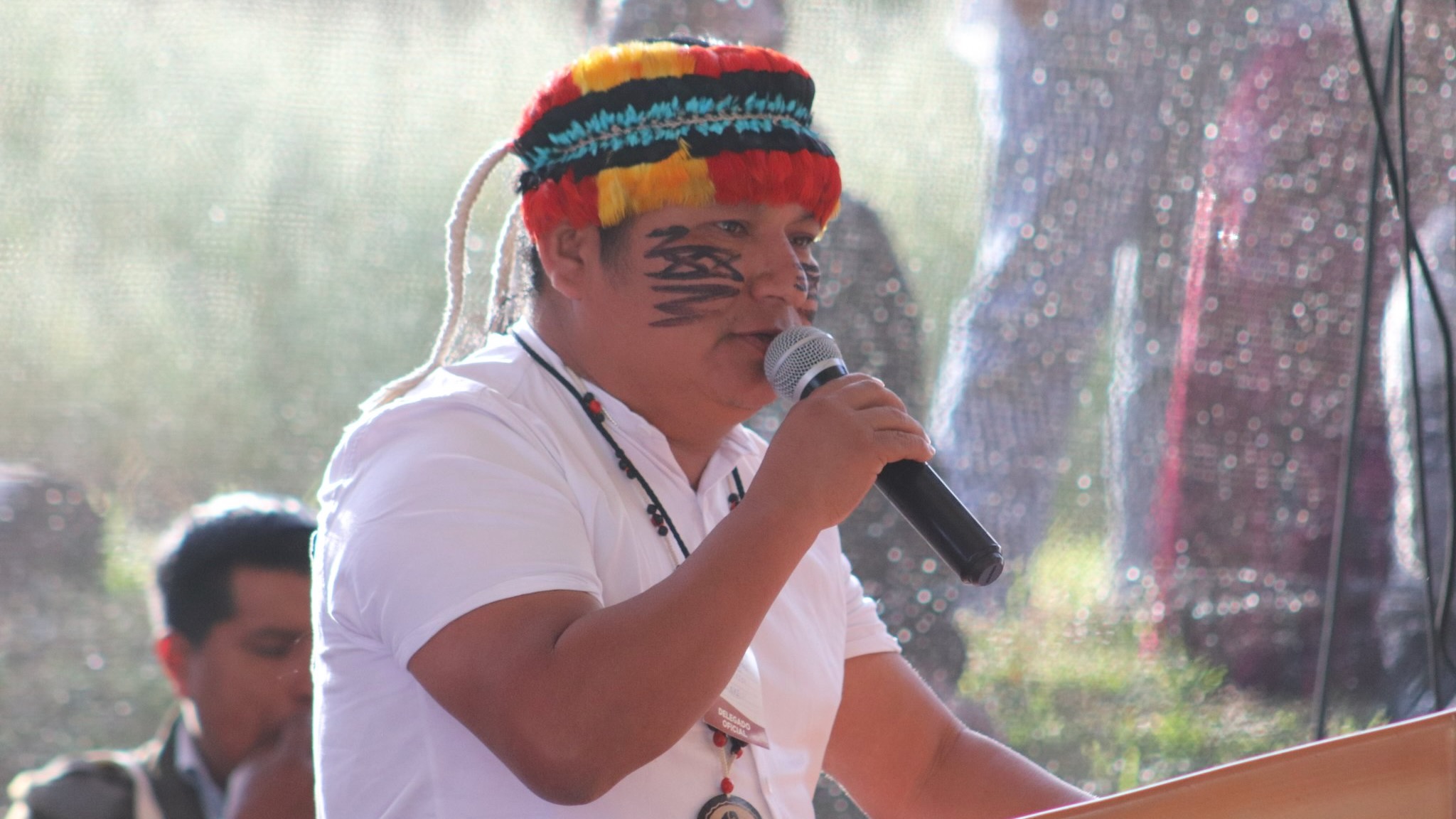
The election process for the new CONAIE Government Council for the period 2025 - 2028. Photo: CONAIE
On July 20, 2025, during the eighth congress of the Confederation of Indigenous Nationalities of Ecuador (CONAIE), Marlon Richard Vargas Santi was elected president of Ecuador’s largest social and Indigenous organization for the 2025-2028 term. The inauguration will take place on July 28, 2025.
Vargas obtained 617 votes from Indigenous leaders, compared to 540 votes for Leonidas Iza, the current president of CONAIE, who was seeking re-election. Both candidates were proposed by the organization’s membership.
CONAIE is one of the most important grassroots organization in Ecuador, not only because of its complex system of democratic election of authorities, but also because of its powerful capacity for mass mobilization from the 1990s to the present day. In recent years, two anti-neoliberal mobilizations led by CONAIE (the first in 2019 and the second in 2022) challenged the governments of Lenin Moreno (2017-2021) and Guillermo Lasso (2021-2023).
CONAIE represents 15 nationalities and 18 Indigenous peoples and maintains close relations with various popular sectors. The organization defends collective rights and community power to govern their territories. The organization began in 1980 with the creation of CONACNIE (National Council for the Coordination of Indigenous Nationalities) to strengthen, organize, and defend the Indigenous peoples of Ecuador.
The Congress was held in the town of Conocoto, Quito, between July 18 and 20, 2025, at the Pichincha International Center for the Integration of Peoples (CIIP), where more than 1,600 delegates who are part of the movement gathered.
Vargas and Iza
Vargas, 49, was born in Capahuari, an Indigenous community in the Amazonian province of Pastaza, and is a member of the Achuar Indigenous group. He has held important positions in the Amazon region. In 2016 and 2020, Vargas was elected president of the Confederation of Nationalities of the Amazon of Ecuador (CONFENAIE) and previously served as vice president and communications director of the Achuar Nationality of Ecuador.
In addition, Vargas was one of the leaders of the October 2019 social mobilizations against former President Lenin Moreno, over the economic adjustments that the government had agreed to with the International Monetary Fund, including the elimination of gasoline subsidies. He also took part in the June 2022 mobilizations against the economic policies of former President Guillermo Lasso.
Read more: Defying repression, tens of thousands of Ecuadorians take part in national strike
The outgoing president, Leonidas Iza, was the central figure in the national protests of 2019 and 2022, thus becoming one of the most important opposition figures to the governments of Lenin Moreno, Guillermo Lasso, and Daniel Noboa. He also participated in the last presidential elections, coming in third with 5.25% of the vote, which was a surprise given the high degree of polarization between the current government and the Citizen Revolution party of former President Rafael Correa (2007-2017).
At the end of the voting, Iza thanked the organization and congratulated Vargas, advising him not to be influenced by those on the right. Iza received words of gratitude and applause from members of the organization, as well as criticism from others. In addition, the current president of CONAIE, through X, congratulated Vargas again, highlighting his participation in the October 2019 and June 2022 mobilizations, and predicted success in his administration: “May dissent allow us to elevate the debate for a more just society, and may the mandate of the VIII Congress of the Indigenous Movement be the compass that guides the actions of the new Governing Council.”
A difficult mandate for Vargas
Many analysts remain skeptical about whether Vargas will maintain the same confrontational and oppositional stance that Iza has adopted toward the Noboa administration. However, the grassroots supporters approved a work agenda that Vargas will have to address if he wants to maintain the support of most of the leaders.
Approximately seven of the 65 mandates proclaimed during the congress focus on the protection of natural resources and the rejection of extractive activities in the areas of mining and oil, projects that are part of the controversial agenda of President Daniel Noboa: “[CONAIE] will not engage in dialogue with the government on extractive issues as long as the violation of collective rights and the criminalization of nature defenders continues,” states the collective document.
Another important development is that during the congress, it was decided that the six legislators from Pachakutik, the electoral arm of CONAIE who currently vote in line with Noboa’s government, will be expelled from the organization.
In his first statements as president of CONAIE, Vargas called for unity among the peoples and nationalities of Ecuador and declared that they will be open to dialogue both within and outside the Indigenous movement: “Dialogue will always be upfront, transparent, and serious, with results. It has to be a dignified dialogue because we cannot engage in dialogue without results while we have problems with health, the economy, production, and education in the territories of the three regions… We will be open to dialogue first among ourselves and then with the authorities. We will not be obedient when they come to try to impose an agenda on us. We will not give up the historic struggle of our peoples. We know how to dialogue, but we also know how to resist.”
Reactions to Vargas’ election
On behalf of the executive branch, Secretary of Government José de la Gasca stated during an interview on Radio Democracia that Vargas’ election as leader of CONAIE would open the door to dialogue in search of consensus and solutions: “The bridges are open; the lines of communication with those bases have existed. There is no reason to be surprised if tomorrow we sit down at the table, if suddenly you see him sitting with the president (Daniel Noboa) in Carondelet.” La Gasca also mentioned that these elections represent a defeat for Iza and Correísmo.
For its part, the Communist Party of Ecuador welcomed Vargas’ election: “We are familiar with [Vargas’] history of struggle and we know that rapacious external interests are seeking to divert and undermine CONAIE’s struggle. But we are confident that Marlon will be able to remove the elements that are traitorous to the political project, such as the expelled Pachakutik assembly members.”
In addition, the PCE recognized the leadership of Leonidas Iza and his political legacy: “Iza is and will continue to be a key figure for the Ecuadorian left, because he represents one of the most powerful syntheses between the Indigenous movement, critical thinking, and revolutionary commitment.”