Violence is an institution of capital, says land rights group
Unpublished Atlas reveals that 44% of cases occurred in the Amazon; 2,000 people were murdered
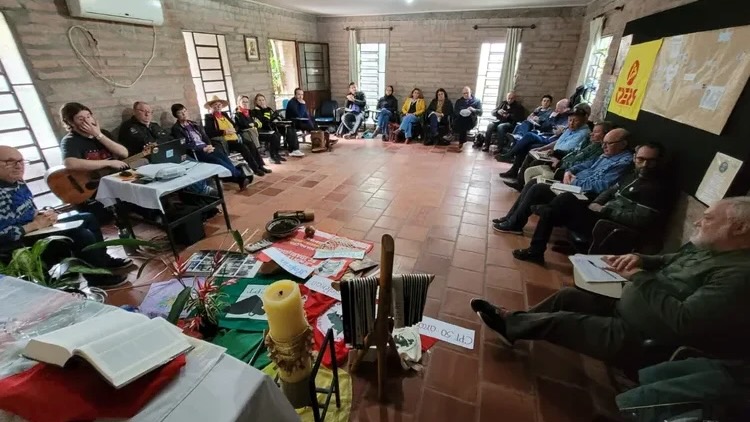
Regional assembly prepares for CPT's 50th anniversary congress. Photo: Corbari/BdF
The Pastoral Land Commission (CPT) launched on Monday, July 21, during the 5th National Congress of the catholic organization in São Luís, Maranhão, the “Atlas of Conflicts in the Brazilian Countryside”. The unprecedented publication records 50,950 occurrences of conflicts in rural areas between 1985 and 2023. Almost half of the cases (44%) occurred in the Legal Amazon. The Atlas also reveals 2,008 murders due to conflicts in rural areas. The Amazon also leads this index, with 66.8% of deaths.
“The Atlas is an extraordinary tool for understanding the mechanism of violence, the use of violence as a way to prevent access to and permanence in lands and territories,” said Carlos Lima, national coordinator of the CPT, in an interview with Conexão BdF. According to him, the material fulfills a long-held dream of geographer Carlos Walter (1949-2023), who worked with the CPT until his death.
For Lima, violence is not an accident, but part of the logic of capital expansion over traditional territories. “Violence is the institution used by agribusiness, it is the institution used by mining companies. So it is part of the mechanism they use to free up land for excessive use by capital,” he says. Among the cases recorded, 84% are land disputes, 8.9% involve slave labor, and 7.1% refer to conflicts over water.
The survey shows that 80% of the violence is perpetrated by companies, farmers, mining companies, or the state itself, while actions by popular movements, such as occupations and encampments, represent only 20% of the total. “This refutes the argument that violence is caused by workers. Even when the number of repossessions decreases, the violence continues unabated,” says the coordinator.
Between 1985 and 2023, 4,559 conflicts involving Indigenous peoples were recorded, more than half of which occurred in the last five years alone. Indigenous people are the third most affected group by violent actions against occupation and land tenure, behind only landless workers and squatters. “Where there are people, the forests are standing, the waters are clean, there is hunting and fishing. These territories are ‘pearls’ for capital,” denounces Lima.
Breaking down fences and weaving webs
The “Atlas of Conflicts in the Brazilian Countryside” was launched during the Congress marking the 50th anniversary of the CPT, celebrated under the slogan “Breaking down fences and weaving webs: the land belongs to God!” The event brings together a thousand participants and continues until Friday, July 25, with debates, thematic tents, cultural activities, and a walk in honor of the martyrs of the struggle for land, such as Father Ezequiel Ramin, assassinated 40 years ago.
The meeting is expected to end with the release of a letter to Brazilian society, based on the statements of the communities present. “This Congress is a meeting of peoples, of communities, a listening, a lot of talking by the people, so that the CPT can be guided, following this pastoral service based on reality,” explains Carlos Lima.
This article was first published by Brasil de Fato in Portuguese.