Tariffs on Latin America: mapping the new trade taxes
In this article, we review the different tariffs that will be applied to Latin American countries and the reasons behind their variation.
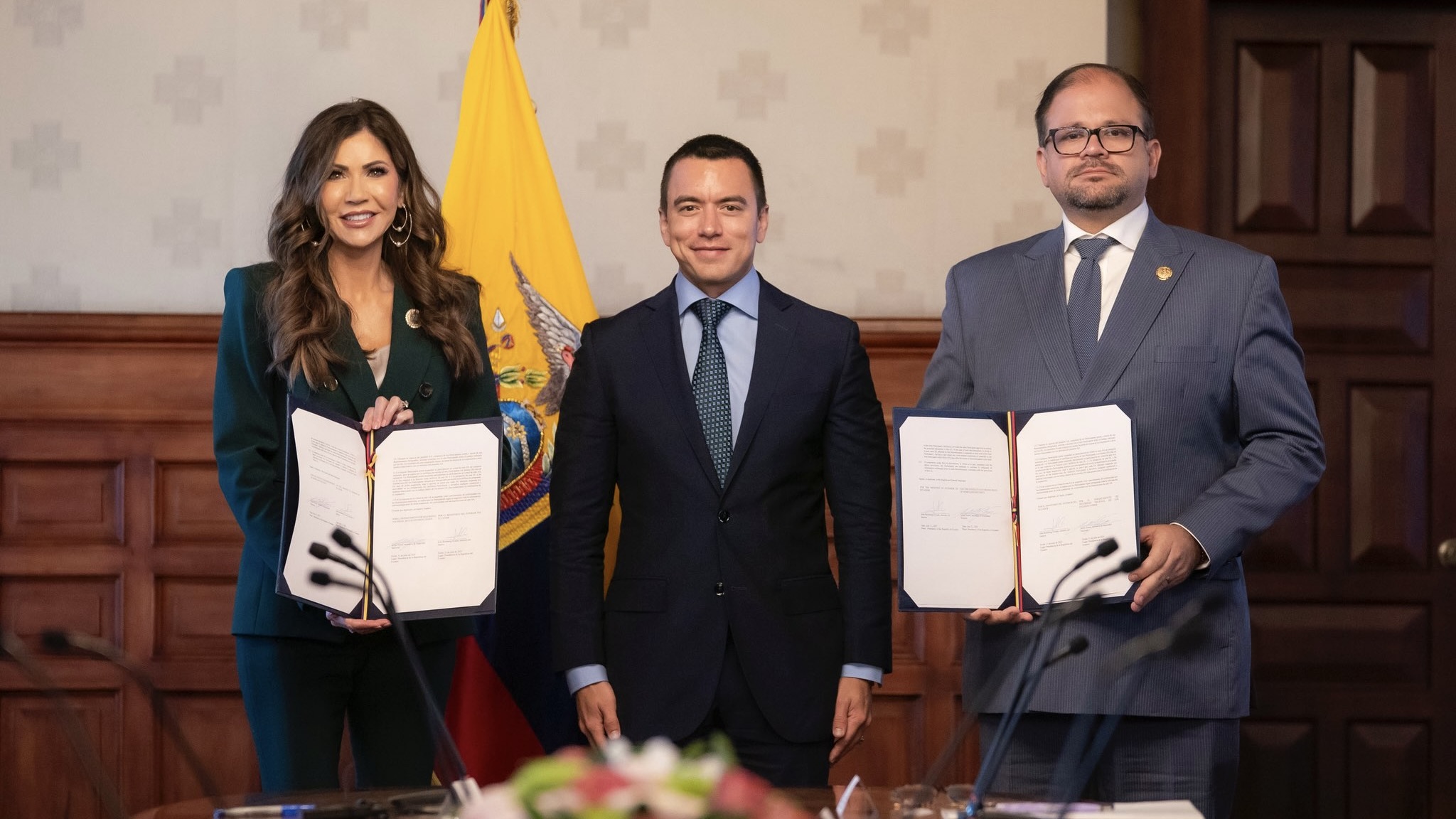
US Secretary of Homeland Security Kristi Noem met with Ecuadorian President Daniel Noboa on July 31, 2025. Photo: Kristi Noem / X
The Trump administration has insisted on using tariffs as a means of pressuring countries with the hope of obtaining something in return. While this may be seen as punishment, it is not unreasonable to think that the protectionist measures, beyond the justifications given in press statements, seek to revitalize industries that are threatened by the rise of production in other parts of the world, such as in several Asian, African, and Latin American countries.
Additionally, the policy has led to an exponential increase in US customs revenues. In June 2024, this source of revenue approached USD 10 billion, while by June 2025, customs revenue had risen to almost USD 30 billion, representing a threefold increase.
This increase will be even more pronounced after August 7, the date in which the Trump administration is set to begin imposing widespread tariffs on its trading partners.
Latin America navigates US trade pressure
In the case of Latin America, countries in the region have viewed Trump’s plan with great concern, as for almost 120 years, the United States – sometimes through coercive measures and other times through diplomacy – has remained the region’s primary trading partner generally.
Countries such as Brazil and Chile have indeed turned their gaze to the other side of the Pacific, but this does not mean that the economic and geopolitical influence of the United States has ceased to be a kind of regional leviathan.
One of the clearest examples of this paradoxical situation is Mexico, whose president, Claudia Sheinbaum, secured an extension for several products that will not be subject to the new tariffs, thanks to strategic diplomatic maneuvering. Initially, Mexico was supposed to pay one of the highest rates of all American countries: 25%, while Canada, the other major neighbor of the United States, received a tariff of 35%.
Sheinbaum, who does not share Trump’s political views, achieved this extension through pure political pragmatism, an approach criticized by those who want to see a more confrontational stance toward Washington’s impositions and applauded by others who see her handling of geo-economics as worthy of a true stateswoman.
But this is not the situation of most Latin American countries, who, despite their efforts – some more admirable than others – failed to stop Washington’s tariff machinery, which officially started on July 31.
Read more: Tariffs, threats, and economic sanctions: Trump’s tense relationship with Latin America
Brazil in the crosshairs of Trump’s trade war
The most striking case is that of Brazil. Trump has imposed an exorbitant 50% tariff on the South American giant. In response, the president of the Amazonian country, Lula da Silva, announced that he will impose a similar tariff on US products.
According to Trump, the high tariff is being imposed in retaliation for the alleged political persecution of former president Jair Bolsonaro, who is accused by the Brazilian justice system of participating in a plot to prevent Lula from taking office.
Despite Lula’s attempts to overcome the diplomatic crisis, tariffs remain extremely high. Some have seen Trump’s decision as more than just a way to pressure Brazil to clear his friend Bolsonaro of charges. Brazil, a regional power, has become China’s main trading partner in Latin America, a shift that the White House disapproves of as it seeks to regain absolute control over its “backyard”.
Perhaps this better explains why a clear US ally like Ecuador, led by right-wing President Daniel Noboa, received no tariff “benefit”, unlike its neighbors Peru and Colombia. The latter, despite having had real diplomatic impasses with the US under President Gustavo Petro, received the lowest tariff in the region: 10%.
A few days ago, US Secretary of Homeland Security Kristi Noem said in Quito that Ecuador is one of its most important regional allies after signing a new security agreement.
Despite this, Ecuadorian exporters will now have to take into account a 15% tariff tax. This seems to reinforce the thesis that tariffs are not necessarily a political tax, but rather part of a plan that is more complex than meets the eye.
Other countries enjoying the lowest rates are Chile, Argentina, Uruguay, Paraguay, Suriname, Panama, Honduras, El Salvador, Guatemala, Belize, the Dominican Republic, and Haiti. Meanwhile, Bolivia, Guyana, Costa Rica, and – to the surprise of many – Venezuela will have a 15% tariff. On the other hand, Nicaragua will have a special tariff of 18%.
The Trump administration’s geo-economic and geopolitical moves could yield positive results for them: the threat of increased tariffs if Washington’s economic policy is not followed could force several governments in the region, many of which are clearly supported by commercial and economic elites, to make concessions on their sovereignty.
However, it is not impossible to imagine that this approach could backfire on the United States and make trade with other parts of the world more appealing, especially with Asia, which is growing demographically at a steady rate and will need even more goods and products to sustain its various civilizational projects.