Tensions rise in Ecuador as President Noboa protests against the Constitutional Court
The Ecuadorian president has decided to confront the Constitutional Court, which has partially blocked his controversial laws, in the streets and at the polls.
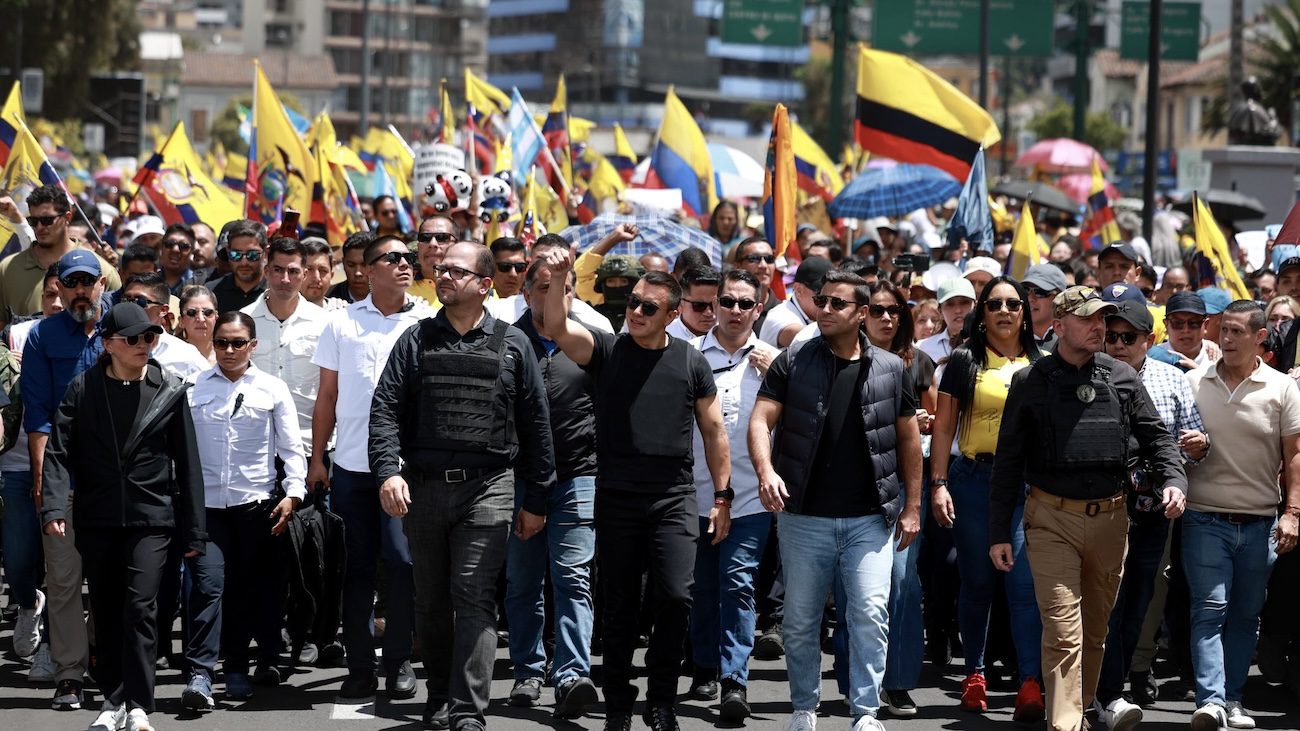
Ecuadorian President Daniel Noboa leading a mobilization on August 12, 2025. Photo: Daniel Noboa / X
Tensions between Ecuadorian President Daniel Noboa and the Constitutional Court (CC) are increasing with each passing day. On August 12, the right-wing leader led a mobilization, alongside his ministers and assembly members, to criticize the recent actions of the CC, which he has described as an “obstacle” to achieving peace.
The CC has recently annulled several articles of the latest laws passed by the ruling party. According to the highest body responsible for ensuring the correct application of the Constitution of the Republic, these articles violate fundamental principles and rights enshrined in the Constitution and have therefore been suspended, although the rest of the laws remain in force.
The articles suspended by the CC
Among the suspended articles are those of the Organic Law on Intelligence, which allowed the executive branch to interrupt citizens’ right to privacy without a court order, as well as the acquisition of false identities by security agents.
In addition, the article that allowed the executive branch to grant “early pardons” to police and military personnel prosecuted for crimes in the so-called “internal armed conflict”, which was declared in 2024 by Noboa himself, was also suspended. Another article that was rejected by the CC was the one that allowed any “structured group of three or more people with an organized power structure that exercises prolonged violence against the state, the population, and civilian property” to be declared an organized armed group.
In addition, all savings and credit cooperatives in the country were prohibited from acquiring the structure of a bank (i.e., a private sector corporation), which could destroy all forms of popular and solidarity-based economy that are precisely safeguarded in the constitution.
A controversial mobilization
Thousands of protesters arrived in buses early in the morning in Quito to join the rally called a few days earlier by Noboa, who, after arriving late to the mobilization, marched alongside his supporters to the CC.
Several media outlets reported that many of the protesters were public officials who were forced to take to the streets, while others claimed that those who attended the demonstration were being paid 20 USD. A video even shows a protest organizer with a wad of cash talking to several people, something that has caused outrage in various sectors of public opinion.
Many were surprised that large banners displaying the faces and names of the CC judges were installed along the march route, which many have claimed is a clear form of “moral lynching” and intimidation for not having aligned themselves behind the executive branch’s political, economic, and security agenda.
In this regard, Leonidas Iza posted on X: “In other societies, to combat crime, images of the most dangerous criminals and mafia leaders are publicized, but in Ecuador, Daniel Noboa’s plutocratic government, with fascist practices like the worst regimes, displays the faces of Constitutional Court judges on large billboards, simply because they have blocked laws that contradict the Constitution and international treaties, perverse laws that violate the basic rights of Ecuadorians.”
When they arrived at the CC, Noboa gave a very brief speech that lasted less than three minutes, and almost all his supporters were unable to hear it due to the terrible sound system.
However, several media outlets managed to record the president’s words, who said in his brief speech: “Thousands of people here are demanding justice, demanding support for our law enforcement agencies. These are the people who want peace, who are the majority … who want strong law enforcement. We will not allow them to stop us! We will not allow change to be stalled by nine [CC judges] … who seek to hide their names and faces from society.”
Reactions to the mobilization
There have been numerous reactions to the mobilization. One of the most significant criticisms came from the United Nations. Volker Türk, High Commissioner for Human Rights, said: “Attacks against Ecuador’s Constitutional Court are unacceptable. The authorities must guarantee the Court’s independence and the safety of judges and personnel.”
For its part, the CC said in a statement that it respected the right of citizens to freedom of movement. However, in the context of the August 12 march, “the security, independence, and autonomy of constitutional justice” were not respected.
“The perimeter fence normally installed outside the Constitutional Court was removed without notice on the afternoon of Monday, August 11. The perimeter of the institution has been completely militarized, with an unusual deployment of Armed Forces, with hundreds of troops … During the march, billboards with the faces of judges of the Constitutional Court were placed along the route, which constitutes stigmatization that increases the risk to their safety and personal integrity and directly affects the independence of this body,” added the CC.
For his part, Interior Minister John Reimberg defended the mobilization: “The people are the principal, and the people demand security. That is what we have done and what we will continue to do in this fight for the security of all Ecuadorians. The president has been very clear with us. We have to achieve peace at any cost.”
Contrary to this view, journalist María Sol Borja stated that what really bothers Noboa’s government is precisely the democratic system: “This visual and discursive strategy sought to personify the supposed obstacle to security, publicly identifying the magistrates of the Constitutional Court by misrepresenting a decision that is part of their jurisdiction – temporarily suspending the articles in question – in order to position them as directly responsible for the violence plaguing the country.”
A referendum to control the CC?
Noboa decided to respond to the CC not only with a demonstration, but also by announcing that in the next referendum. With the referendum, the executive branch hopes to reinstate military bases for foreign forces, reopen casinos, and approve hourly work for tourism businesses, among other things – CC judges could be politically impeached, meaning that the National Assembly could censure them and, consequently, remove them from office.
This plan to subordinate the CC judges to the ruling political power – a move that, ironically, must be approved by the CC itself to be included in the referendum – has been questioned by almost the entire left, but also by several sectors of the right, who see it as a very clear threat to democracy, the separation of powers, and the very structure of the state.
Henry Cucalón, former minister in the right-wing government of Guillermo Lasso (2021-2023) and former presidential candidate, said: “They know what they want: total control. [The executive branch] still does not know how to do it … The goal is to co-opt the constitutional judges … and that is not good for democracy in Ecuador.”
A lot of people were surprised by former President Rafael Correa’s (2007-2027) support for Noboa’s government’s move to politically control the judges of the CC, an institution that also caused several “headaches” for his administration. When mentioning how to vote on each of the possible questions in the referendum, Correa said that people should vote “Yes” on the question regarding the CC: “YES. Making the Constitutional Court untouchable is characteristic of more mature democracies. Since the CC was illegally replaced during the Trujillo regime, this body has been susceptible to manipulation. It is the lesser evil, although I repeat: there will be no virtuous institutions without virtuous individuals.”
On the other hand, Indigenous leader and former presidential candidate Leonidas Iza wrote: “We are facing a totalitarian and abusive regime that seeks to violate all norms to do what suits the economic group of family and friends who applaud the abuses and destruction of the constitutional rule of law in order to move to a dictatorial regime, believing that Ecuador is a banana plantation. What a historic disgrace!”
Noboa bets on mobilization
This is the first time Noboa has carried out a mobilization of this nature. As the government is well aware, there have been regular demonstrations against the neoliberal decisions of the executive and legislative branches for several days now.
In response, Noboa has decided to confront his opponents in the streets as well, which could spell even greater political instability for the country.
In any case, Noboa’s administration seems unwilling to back down from its political agenda, even if it means confronting the very structure of the constitution, which must be reconfigured by a new state structure “whatever the cost,” as the Minister of the Interior said.