Organizations from the African continent launch day of solidarity with the Alliance of Sahel States
Pan Africanism Today Secretariat rallies global solidarity as Sahel nations mark two years of defying neocolonial rule
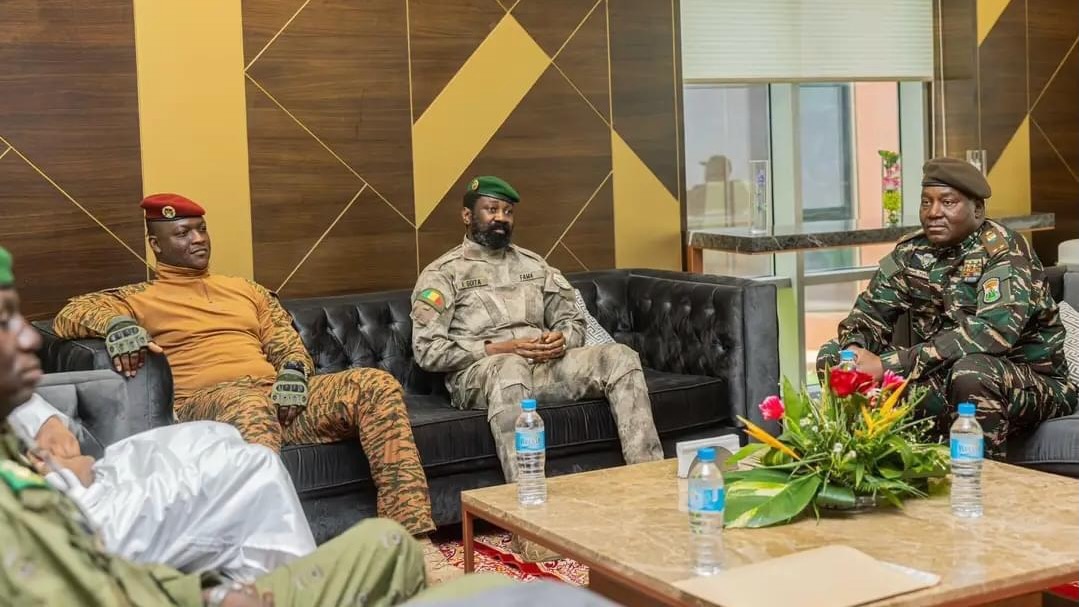
(Left to right) Captain Ibrahim Traoré of Burkina Faso, Colonel Assimi Goïta of Mali, and General Abdourahamane Tchiani of Niger. Photo: CGTN
As the second anniversary of the Alliance of Sahel States approaches on September 16, 2025, the Pan Africanism Today Secretariat (PAT), composed of over 70 people’s movements and organizations across Africa, has issued a call to action, urging all progressive forces across the continent and around the globe to stand in solidarity with the AES.
According to PAT, this would entail publicly declaring solidarity with the peoples of Burkina Faso, Mali, and Niger, amplifing the political significance of the Alliance of Sahel States (AES), and exposing the role of imperialist powers and ECOWAS in undermining their sovereignty.
Movements are urged to organize mass mobilizations, protests, and other coordinated actions on September 16, 2025 to mark the AES’s second anniversary, as well as host educational events, forums, and teach-ins to deepen political understanding of the struggle. Cultural and creative expressions, along with bold acts of agitation and disruption, should be used to communicate the AES’s vision, challenge neocolonialism, and integrate solidarity into ongoing political activities.
“Over the past few years, the peoples of Burkina Faso, Mali, and Niger have waged struggles to break free from the stranglehold of neocolonial domination, forging a new Pan African path toward self-determination, popular sovereignty, and regional unity under the banner of the AES,” writes the Secretariat. “The West, backed by its local collaborators, including the Economic Community of West African States (ECOWAS), continues to develop schemes to destabilize and undermine the popular, patriotic forces leading this anti-imperialist transformation.”
Last year, from November 19 to 21, delegates from popular movements, labor unions, peasant organizations, and left parties in Africa, Asia, Latin America, and the US arrived in Niamey, the capital of Niger, to attend the “Conference in Solidarity with the Peoples of the Sahel”. PAT and the West Africa People’s Organization (WAPO) organized the conference under the banner “For Anti-Imperialist Unity, Peace, and Friendship between Peoples.” The conference was a milestone in the deepening of popular, international support for the processes in the Sahel.
New dossier examines Sahel alliance’s fight for sovereignty
A new dossier by the Tricontinental Institute for Social Research explores how the nations in the Alliance are seeking sovereignty from a devastating legacy of colonialism and neocolonialism, while “navigating a legacy of dependency and internal-external security challenges.” Some obstacles include the threat of military intervention in Niger on the part of the Economic Community of West African States (ECOWAS), sanctions by both ECOWAS and the African Union (AU) against the Sahel states, as well as breaking the economies of the Sahel states from “extractive resource dependency.”
“The threats of sanctions, isolation, and military intervention are not only attacks on the AES governments, but they are attacks on the African people who have fought and continue to struggle to determine their own future,” writes the Pan Africanism Today Secretariat.
It is in the context of the pursuit of sovereignty that the leaders of Niger, Mali, and Burkina Faso announced the formation of the “Alliance of Sahel States” on September 16, 2023. The creation of the AES was a direct countermeasure to the ECOWAS threat of military intervention.
Additional moves in the pursuit of sovereignty include, but are not limited to, additional collaboration with Russia and China for resource extraction to break the economic monopolies of the West, the participation of popular organizations in the shaping of the national agendas of the states, and the creation of Pan-African, anti-imperialist national programs.
“The emerging paradigm in the Sahel remains fragile, but it reflects a decisive rejection of the imperial command model and a political horizon aligned with the emancipatory aspirations of the Global South,” concludes the dossier.