Peru’s former PM Betssy Chávez has launched a hunger strike in prison
The former PM has been in prison since the coup against Pedro Castillo. In her latest letter, she announced she was embarking on a hunger strike, explicitly stating she does not wish to be revived.
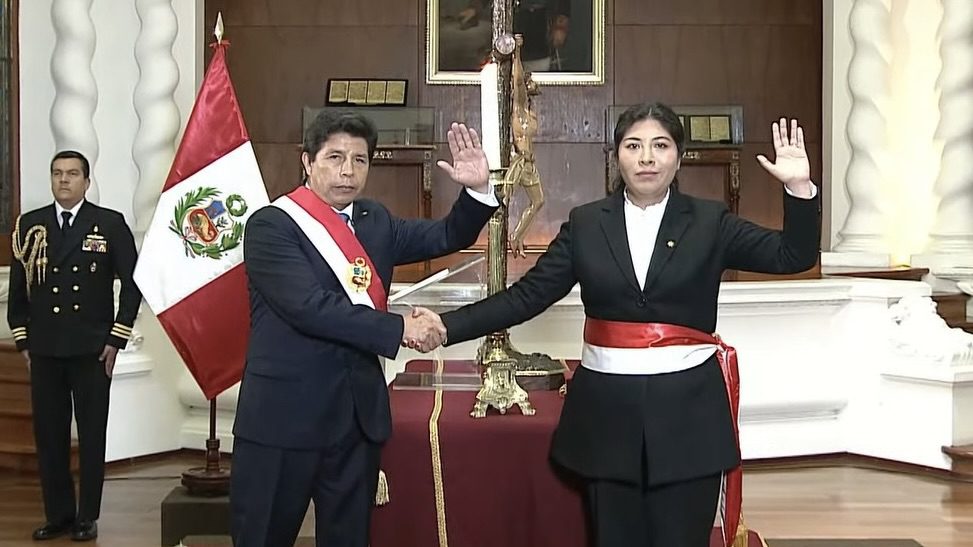
Former President Pedro Castillo at the swearing-in ceremony of former PM Betssy Chávez. Photo: Presidencia Perú
On August 12, former Prime Minister of Peru Betssy Chávez signed a letter announcing, among other things, that in protest of her imprisonment and the harassment she claims to be suffering at the hands of her jailers, she would go on a dry hunger strike (i.e., she will not consume any food or liquids).
Chávez herself has called her letter a testament, meaning that it is a kind of last will. In it, she explains that she does not wish to be resuscitated or saved when she dies. The reason she gives is that, according to her, she has been mistreated in inhumane ways by the National Penitentiary Institute, attached to the Ministry of Justice, “which reports directly to Ms. Dina Boluarte”, de facto president of Peru. In addition, she pointed out that she does not expect anything to change, which is why some analysts see her letter as a farewell.
Allegations of torture
Chávez states that “the continuous deterioration [of her condition makes it impossible for her] to attend court proceedings as she had been doing, due to the constant harassment, mistreatment, and torture that not only have not ceased but are getting worse every day, preventing me from even going to the bathroom, making death threats against me, and not allowing me to meet with my legal defense team.”
In addition, Chávez reported that her guards have drugged her before she attends court proceedings with drugs such as “fluoxetine and/or alprazolam”, which completely limits her participation in them. “The goal is to prevent me from defending myself in court and to have me attend only as a figurehead, since they send me there drugged,” she said in her latest letter.
Chávez has been detained since 2022 on charges by the prosecution of participating in an alleged coup attempt led by former President Pedro Castillo. These accusations have been repeatedly denied by Chávez and Castillo, who is also in custody.
Following Castillo’s imprisonment, his vice president, Dina Boluarte, took over the executive branch, initiating a harsh crackdown on the hundreds of thousands of Peruvians who protested for months in 2022 and 2023 against her inauguration and Castillo’s imprisonment. Amnesty International stated that the Boluarte government is directly or indirectly responsible for the deaths of more than 50 Peruvians during those protests.
For his part, former President Pedro Castillo, who is also in prison, said in a statement: “I hold the regime of the usurper Dina Boluarte directly responsible for the life and integrity of Betssy Chavez, who is unjustly imprisoned and subjected to degrading and inhuman treatment that today puts her health at serious risk and seriously threatens her existence in the Chorrillos prison.”
“Chávez is a political prisoner”
Peoples Dispatch spoke with Peruvian sociologist Lucía Alvites, who emphasized that Chávez’s arrest represents a clear instance of lawfare, in which the justice system is used to persecute political opponents. Alvites stated, “Betssy Chávez is the victim of lawfare, driven by a media circus and unproven accusations. This strategy serves as political pressure, and Chávez is a political prisoner under Dina Boluarte’s regime, alongside others targeted for defending the 2021 election result.”
Alvites also pointed out that Chávez’s imprisonment seeks to regulate political behavior in some way: “Behind Betssy Chávez’s imprisonment is a disciplinary measure by Dina Boluarte’s dictatorship to tell citizens and political actors who do not support the traditional option (which has governed the country for decades and has failed) that this [imprisonment] is what could happen to them if they try to be an alternative government.”
The Peruvian sociologist also pointed out that Chávez’s allegations of death threats, inhumane treatment, and other abuses are not recent, but have been made for several months. “This constitutes a systematic violation of Betssy Chávez’s human and fundamental rights, and unacceptable violence, which would be considered torture anywhere in the world.”
Finally, Alvites affirms that there are clear political interests behind the legal proceedings against Chávez: “These are the political interests of those who insist on a neoliberal economic and political model that has failed in Peru, which has a very high unemployment rate and, during the pandemic, had one of the highest mortality rates (not because of the virus, but because of a precarious health system).”
“The neoliberal economic model that has governed Peru for decades is why people voted for a non-neoliberal, anti-system option in the last elections, represented by Pedro Castillo, the country’s first indigenous president. In this sense, the political interests of the economic and political elites that have governed Peru for several years are involved, seeking to silence any alternative that seeks to find ways out of this model through human rights violations … The Boluarte government is committed to restoring this model, as well as managing the economy and politics in Peru,” Alvites said.