Sahel’s continued defiance: the AES states and the struggle for sovereignty
A lecture in South Africa explored the rise of the Alliance of Sahel States and the broader struggle for sovereignty, building on the launch of a new Tricontinental dossier on the Sahel.
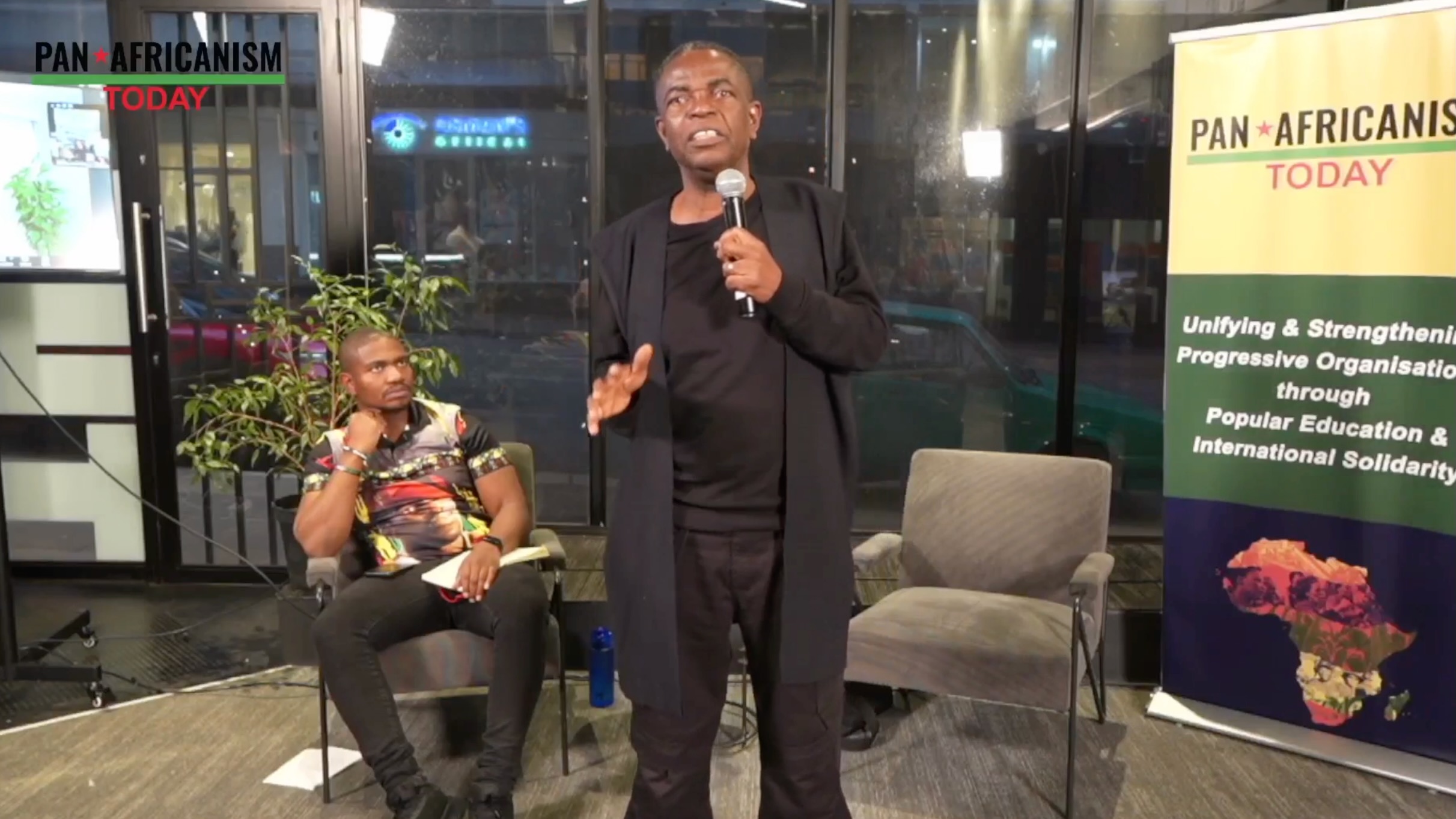
Kwesi Pratt Jnr, General Secretary of the Socialist Movement of Ghana, discusses the significance of the AES in building sovereignty in the 21st century. Photo: screenshot
The bold and historic revolutionary project in the Sahel continues to gain momentum despite external challenges and security needs. On September 16, 2023, Burkina Faso, Mali, and Niger declared the foundation of the Alliance of Sahel States (AES), a political and military bloc that challenges French neocolonial domination.
At a recent lecture convened by Pan Africanism Today, The Forge, the International Peoples’ Assembly, Tricontinental: Institute for Social Research, and the Anti-Fascist International (South Africa Chapter), speakers, including Kwesi Pratt Jnr, General Secretary of the Socialist Movement of Ghana, and Mikaela Erskog of Tricontinental, with facilitation by NUMSA’s head of education Vuyolwethu Toli, examined the roots of this defiance and its implications for Africa and the wider world. The event grappled with crucial questions: Why have the Sahel’s military coups enjoyed mass support? What role have grassroots movements played? And why should Pan-Africanists everywhere see the AES as a beacon of sovereignty?
Rediscovering historical memory
Tricontinental researcher Mikaela Erskog opened the discussion by drawing on a dossier recently launched by the institute, situating today’s upheavals within the long arc of African struggles for liberation. Noting that African soldiers who fought in World War II returned with expectations of freedom, only to see independence betrayed in the 1960s. Nowhere was this clearer than in Niger, where a 1961 defense agreement handed France near-total control of Niger’s uranium, the fuel that powers a third of France’s electricity grid while Niger itself remained among the world’s poorest nations.
“Sovereignty,” Erskog stressed, “can never be handed down. It must be fought for.” Highlighting that while Western commentary often portrays coups as the mere capture of power, in the Sahel they have been shaped by decades of grassroots mobilizations against poverty, corruption, and foreign domination. The popular encirclement of French military bases in Niamey after Niger’s July 2023 coup exemplified this dynamic: “The demand to expel French troops did not originate with the generals. It came from the people.”
Linking the Sahel to global struggles
Ghanaian leader Kwesi Pratt Jnr. placed the Sahel in a wider global frame. He warned that humanity stands on the brink of destruction, not only from nuclear weapons but from the hunger, exploitation, and divisions within societies that fuel conflict. For Pratt Jnr., the AES represents a frontline in resisting these forces: “We have a duty to ourselves and generations not yet born to build a new world of equal citizens, where no child goes to bed hungry. That is the challenge of the Sahel.”
He traced today’s crises back to 1452, when the Pope issued an official decree called a papal bull, “Dum Diversas”, which sanctioned the enslavement and dispossession of African peoples, laying the foundations for capitalism. Colonialism and neocolonialism, he argued, entrenched a system in which African economies were designed to extract wealth for the metropoles. Niger’s uranium paradox is emblematic: “One year after the coup, Niger became the fastest-growing economy in the world. How can a country so rich in resources have been among the poorest for decades? The answer is neocolonial exploitation.”
Building a new Pan-Africanism
The AES is already moving beyond symbolism. The three governments have revised mining codes, launched a new regional confederation bank, and initiated discussions on a common currency and passport. Cultural initiatives, like Mali’s Pan-African arts festival, are attempts at the ideological task of reclaiming dignity.
These steps recall earlier Pan-African aspirations crushed by colonial “balkanization”. By pledging that “if you touch one, you touch all,” the AES challenges the isolation that has long weakened African states.
The persistent challenge is for the AES to remain a platform for popular sovereignty supported by the masses and not in isolation of the grassroots base.
Read More: Sankara’s revolution rises again
Why solidarity matters
Western governments and ECOWAS have responded to the AES with sanctions and threats, echoing Cold War-era interventions from Congo to Chile. But as emphasized by Kwesi and the other speakers, these pressures reveal precisely why solidarity is urgent. “Those who oppose the Sahel because it does not fit Western definitions of democracy,” Kwesi argued, “are lost. Democracy and capitalism in the West were built on slavery and colonial plunder. Africa must chart its own path.”
The stakes, they insisted, extend beyond the Sahel. AES is not simply a regional bloc, it is a project of sovereignty in the 21st century, bringing to the fore urgent questions about development, independence, and Pan-African unity.