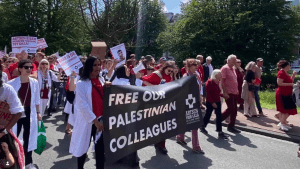
German court sides with Buchenwald Memorial in controversial keffiyeh ban
The decision highlights the tension between freedom of expression and the state’s role in shaping historical memory at former concentration camps.
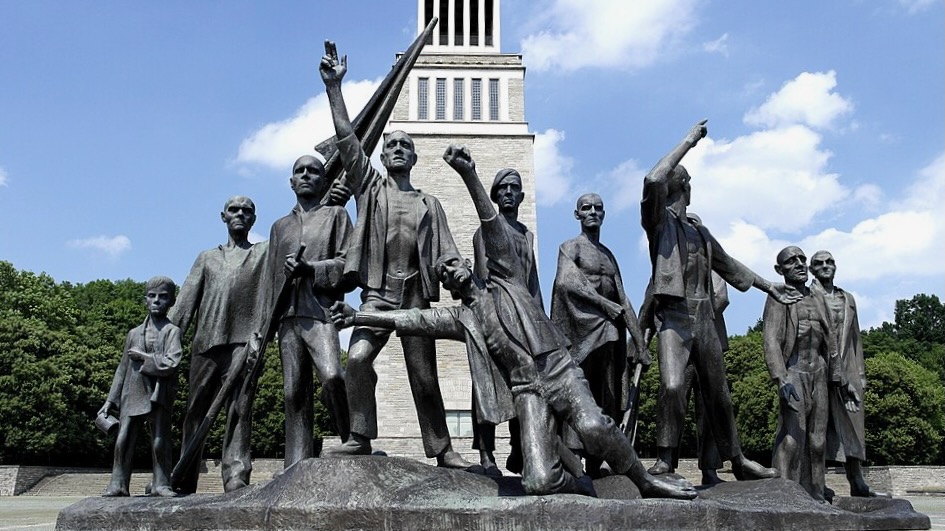
Buchenwald Memorial depicts the history and suffering at Buchenwald concentration camp. Highlighting inhumane conditions, mass killings, forced labor, and the resistance of inmates to liberate themselves. It is a symbol of remembrance of the 51,000 victims of the camp, many of them communists. Photo: wiki commons
The Buchenwald concentration camp was one of the largest on German soil. It also became a central site of political imprisonment: communists in particular were incarcerated there. Ernst Thälmann, the longtime leader of the Communist Party of Germany, was executed in Buchenwald in 1944 on Hitler’s direct orders. In April 1945, prisoners took matters into their own hands and liberated the camp under the leadership of the underground International Camp Committee.
That legacy gave Buchenwald enormous symbolic weight in the German Democratic Republic (GDR), where the antifascist struggle was central to state identity. But since the annexation of the GDR in 1990, the site has been increasingly sidelined. Today, bourgeois historiography often denies the prisoners’ self-liberation, while the GDR’s commemorations are dismissed as propaganda.
From antifascism to “reason of state”
Over the past few years, Buchenwald’s memorial culture has been pulled firmly into line with Germany’s so-called “reason of state” – the official doctrine that unconditional support for Israel is a core pillar of German state identity.
In August 2024, visitors wearing t-shirts with Palestinian symbols and keffiyehs were blocked and kept waiting for a long time, before they could enter the memorial grounds, where they had come to honor Ernst Thälmann. By April 2025, at the official commemoration of the camp’s liberation, the ban had widened: no one displaying Palestinian, Soviet, or Russian symbols was allowed to take part.
That same day, a young delegate, invited by the International Committee Buchenwald-Dora, described Israel’s assault on Gaza as “genocide”. Memorial director Jens-Christian Wagner immediately intervened and denounced the speech later in the media as an “antisemitic attack”.
Just three months later, a leaked internal memo revealed the scope of this policy. The document labeled the keffiyeh itself “antisemitic”, along with other widely recognized Palestinian symbols such as the watermelon and the key, as well as the slogan “Ceasefire Now”. It also blacklisted the BDS movement and a number of left-wing organizations. The Kommunistische Organisation (Communist Organization, KO) was singled out and banned from the premises altogether.
Court sides with the ban
One of the people targeted by these measures was Anna M., a member of the KO who attended both the August 2024 and April 2025 commemorations while wearing a keffiyeh. She took the foundation to court. Anna emphasizes that she is a communist with Jewish roots, her ancestors were persecuted under fascism, and that for her, antifascism is inseparable from solidarity with Palestine.
But in July 2025, the court issued a preliminary ruling in favor of the foundation. In a fast-track proceeding, the judges accepted the claim that there was no general keffiyeh ban, even though the leaked memo explicitly categorized it as “antisemitic“. In effect, the court endorsed the memorial’s policy while denying that such a policy exists.
Anna M. insists this is far from the final word. In a recent video she said: “It cannot be that after almost two years of genocide, we still have to fight to make sure the keffiyeh isn’t criminalized – fight to make sure it isn’t smeared as an antisemitic symbol.” She has called for the foundation’s policies and the court’s ruling to be made public and widely condemned.
Leon Wystrychowski is a former member of the Palästina Solidarität Duisburg (Palestine Solidarity Duisburg, PSDU). The Organization was banned by the German state in 2024.