Lebanese government faces mounting US pressure to advance resistance disarmament
In a speech broadcast on August 25, the Hezbollah leader suggested that the group may return to combat against Israel if the disarmament plan proceeds.
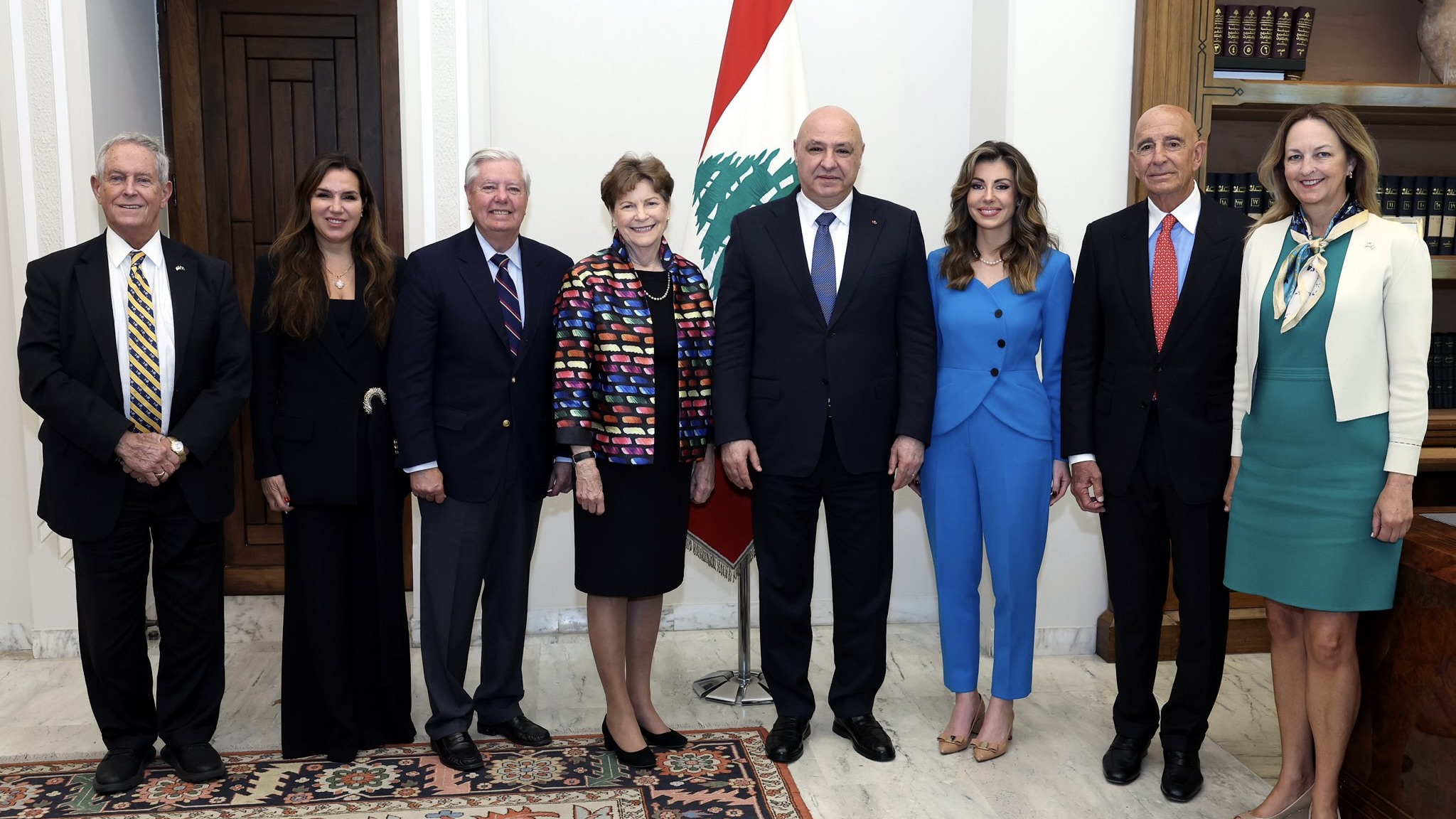
US bipartisan delegation to Lebanon met with Lebanese President Joseph Aoun. Photo: Senate Foreign Affairs Committe Dems / X
Heated political debates regarding the US plan to disarm resistance groups in Lebanon have emerged in the last couple of days following inflammatory statements of US officials, which were preceded by a strongly-worded speech of Hezbollah Secretary-General Sheikh Naim Qassem.
We will never abandon the weapons that protected our dignity: says Sheikh Naim Qassem
Sheikh Naim Qassem warned the Lebanese government on Monday, August 25 to retract its “sinful” and “illegitimate” decision that was made “under US-Israeli dictates”, emphasizing that the United States aims to sabotage Lebanon, and incite discord through its disarmament plan.
The leader of Hezbollah slammed the Lebanese state for making the decision “while Israel continues with its aggression [on Lebanon], and its expansionist intentions under vicious US supervision.”
Qassem cautioned the Lebanese government of continuing with this approach, or it is otherwise “not trustworthy to maintain Lebanon’s sovereignty”.
The resistance leader also reiterated that Hezbollah will never abandon the weapons, which protected the Lebanese people from their enemy and maintained their dignity, nor will the group “allow Israel to roam freely through the country, killing resistance fighters and taking over southern Lebanon.”
US exerts more pressure on Lebanon to expedite the implementation of the plan
Qassem’s speech preceded a press conference of Tom Barrack, US Ambassador to Türkiye and special envoy for Syria, in the Lebanese capital Beirut on Tuesday, August 26, following a meeting with Lebanese President Joseph Aoun.
During the press conference, Barrack announced that the Lebanese government will come up with a plan on Sunday, Aug 31 to convince Hezbollah to disarm.
The US top diplomat added that Israel will present its counter proposal once it receives the plan of the Lebanese state, which “would not necessarily involve military action to persuade Hezbollah to give up its weapons”.
A US congressional delegation that included Democratic Senator Jeanne Shaheen, Senator Lindsey Graham, and Congressman Joe Wilson, joined Barrack’s meeting with the Lebanese President, and gave statements related to the disarmament plan during the press conference.
Shaheen declared her support for the Lebanese state in the disarmament plan, saying: “America will continue to support Lebanon through legislation, and we urge Lebanese leaders to continue on the path they have chosen.”
Meanwhile, Graham’s statements were a bit more incendiary, as he linked the country’s political and economic future to disarming the Lebanese and Palestinian groups in the country, labeling them as Iran-backed “militias”.
In what was interpreted by observers as a bid to sow discord with the Lebanese society and distort the image of resistance groups in Lebanon, the US Senator accused Hezbollah of being committed to sectarian-based agendas not collective national interests.
“This country is going backward, not forward, if you don’t disarm the Palestinians and Hezbollah and make the Lebanese army the central repository of arms,” Graham said.
For his part, Joe Wilson praised the effort that US President Donald Trump has allegedly made for the “Middle East” to become “prosperous, stable and capable of having opportunities for the younger citizens”.
Tom Barrack under fire for comments to reporters
The visit of the US delegation, which revealed the huge pressure exerted by the Trump administration on the Lebanese government to expedite the implementation of the disarmament plan, has already provoked the ire of the Arab grassroots.
Yet, Barrack has added insult to injury during the press conference after he called reporters, who shouted questions after his meeting with Aoun, as “animalistic”,
“We’re going to have a different set of rules. Please be quiet for a moment,” Barrack told reporters.
“The moment that this starts becoming chaotic, like animalistic, we’re gone,” the US envoy added.
“Act civilized, act kind, act tolerant, because this is the problem with what’s happening in the region,” he asserted.
Public apology or boycott: Lebanese Press Syndicate warned Barrack
The Syndicate of Lebanese Press Editors issued a statement on Tuesday, denouncing Barrack’s remarks, and demanding he issue a public apology.
“Once again, the Lebanese media has been subjected to treatment that is, to say the least, beyond the pale of decency and diplomacy. What is even more unfortunate is that it was perpetrated by an envoy of a major power who is, as is well known, performing a diplomatic role,” the statement reads.
The Syndicate described the behavior of the US envoy as “completely unacceptable” and “deeply reprehensible”, noting that the issued statement has been directed “specifically at Mr. Barrack, and US diplomatic officials in general.”
The statement called on Barrack to “rectify his actions by issuing a public apology to the media”, stressing that “failure to issue such a statement could prompt the Syndicate to call for a boycott of the US envoy’s visits and meetings, as a first step toward making it clear to all concerned that the dignity of journalism and journalists is not cheap and that no envoy, no matter how high his rank, can transgress it.”
Lebanese Presidency apologizes on behalf of Barrack
While Tom Barrack has not made a public apology to Lebanese journalists, in an attempt to diffuse public anger, the Lebanese Presidency expressed its regret for the incident in a post published on X:
“The Presidency of the Republic expresses regret for the statements inadvertently made from its platform by one of its guests today.”
The Lebanese Presidency emphasized “its absolute respect for the dignity of the human person in general”, and reaffirmed “its full appreciation for all journalists and accredited media representatives in particular.”
It also extended “its highest regards for their efforts and dedication in fulfilling their professional and national duties.”