Presidential campaigns officially kick off in Honduras
The elections will be held on November 30. Nearly 6 million Hondurans are eligible to cast their votes. In addition, 128 congressmen, 20 deputies, 198 mayors, and 2,000 councilors will be elected.
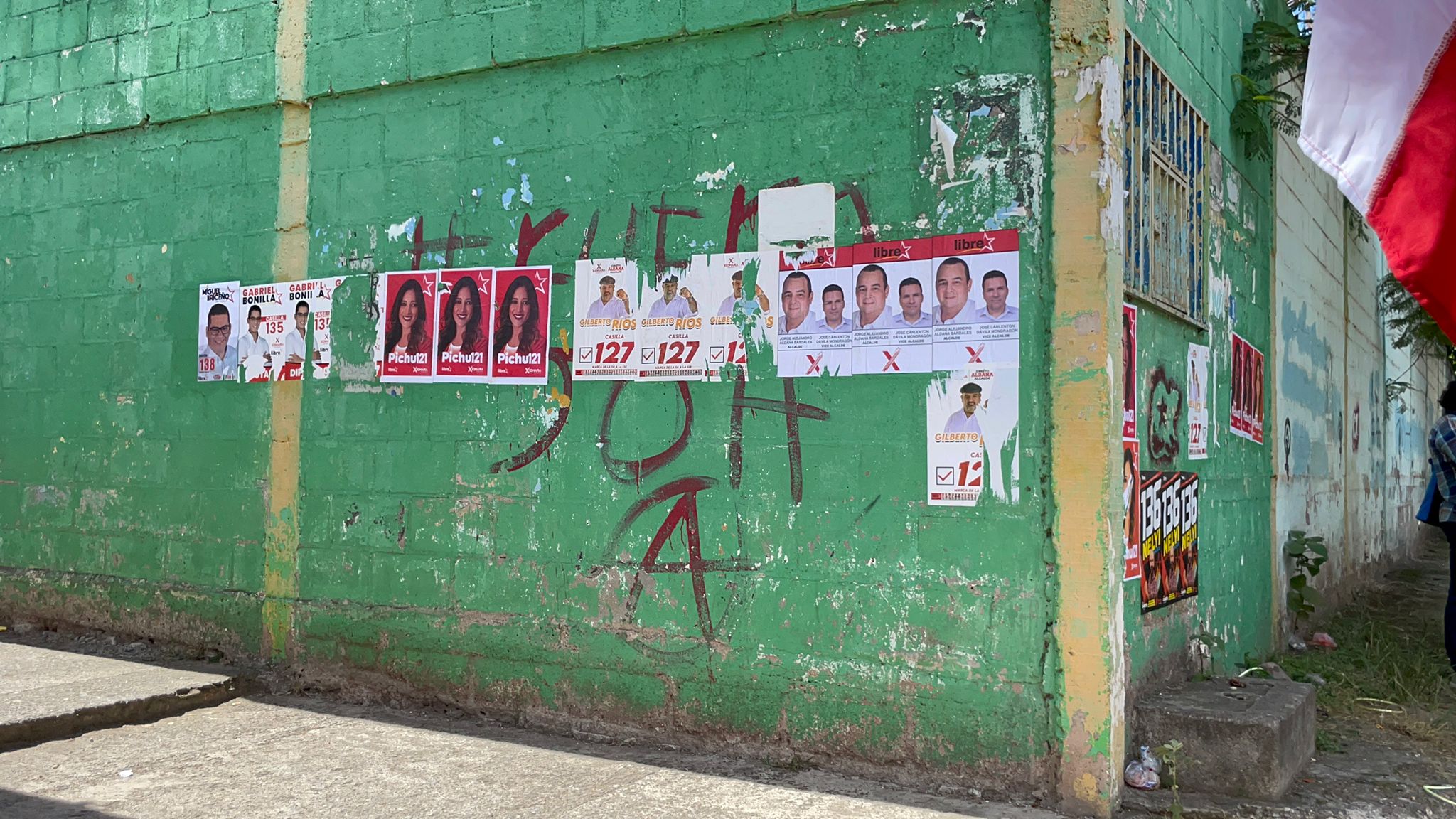
Muro en Honduras antes de las elecciones generales de 2021. Foto: Zoe Alexandra
Lee en español aquí
On September 1, the official election campaign period began in Honduras for the November general elections. Five presidential candidates will compete for the presidential seat in Tegucigalpa, although, according to the latest polls, there are only three major contenders.
President Xiomara Castro’s ruling party is backing her former finance and defense minister, Rixi Moncada. The candidate of the progressive Libertad y Refundación (LIBRE) party, which broke Honduras’ historic two-party system, has promised to continue her predecessor’s social policies and maintain a foreign policy of regional integration and defense of Latin American sovereignty.
Among her initiatives, Moncada has proposed a universal scholarship for young people, continuing health and education projects, and support for farmers, one of the most neglected sectors in the Central American country.
Another serious contender is businessman Nasry “Papi” Asfura of the right-wing National Party of Honduras (PNH), an establishment politician who served as a congressman and mayor of Tegucigalpa. The National Party ruled Honduras for 12 years following the 2009 coup d’état against Manuel Zelaya. One of the party’s most visible leaders, Juan Orlando Hernández, who ruled for a historic two terms after stacking the courts to approve the move, was extradited to the United States and convicted of drug trafficking in 2024.
Finally, Castro’s former vice president and former ally, Salvador Nasralla, has decided to run for president with the support of the Liberal Party of Honduras (PLH). The television presenter has sought the presidency twice – in 2013 and 2017.
The polls are currently mixed, which could be due to biased reporting. On the one hand, pollster TResearch International reported that the ruling party’s candidate, Rixi Moncada, has 50% of the vote. Nasralla trails far behind with 26%, and Asfura is in third place with 17.5%. In contrast, other pollsters place opposition candidates at the top of the polls.
The candidates’ discourses
Moncada, despite constant media attacks from the opposition, continues her tour of Honduras, confident that the work of Xiomara Castro’s government is the best reason to bet on continuity: “They call us communists, but these communists have made the largest public investment in the history of Honduras. While they increased poverty by 20 points, we support the countryside, education, sports, and bring free energy to the people.”
For his part, Nasralla is committed to the discourse of change as a basic communication strategy: “Good Hondurans, regardless of their political leanings, know that the time has come to change and rescue our country from the collapse in which it has been left. THE TIME HAS COME! On November 30, we have a historic opportunity to save Honduras. The future is in your hands, and together we will achieve it.”
Although Asfura also advocates for change, he does so in a more radical way than Nasralla. In fact, the PNH candidate advocates for a discourse closer to freedom and foreign investment: “We will work for young people, single mothers, with investment from Honduran businesspeople, with foreign investment … God willing.”
The three candidates are thus seeking to convince many undecided voters who will undoubtedly decide which of the three political forces achieves the coveted goal. The road will not be easy, as accusations are the order of the day. The candidates will have to overcome these and other obstacles while seeking to secure presidential and mayoral seats in order to have a more agile and effective government.