Political parties in Bangladesh oppose interim government’s changes to the country’s political system
The Muhammad Yunus-led interim government has failed to win the support of the majority of political parties in the country for its ambitious political “reforms”.
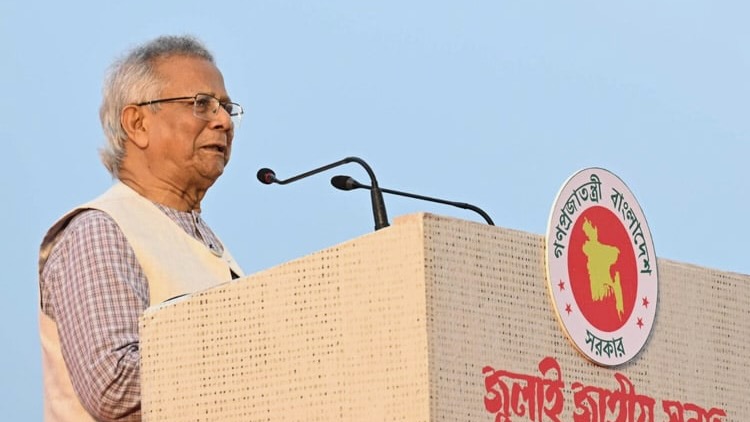
Chief Adviser Professor Muhammad Yunus spoke as the chief guest at the signing ceremony of the July National Charter-2025 at the South Plaza of the Jatiya Sangsad Bhaban October 17. Photo: BSS
Left political formations have objected to fundamental political changes proposed by the interim government in Bangladesh, calling them a threat to the country’s secular, democratic, and socialist character and instead demanded immediate national elections to decide the future of the country.
Marred by unrest and uncertainty since the resignation of Sheikh Hasina’s elected government in August of last year, Bangladesh’s interim government, led by Nobel laureate Muhammad Yunus, adopted a so-called July National Charter last week proposing comprehensive changes to the country’s existing constitution and political system.
The charter was signed and adopted in a ceremony in the national parliament in Dhaka on October 17, with Yunus declaring it the “birth of new Bangladesh” and the basis of new national elections in the country.
Though some parties such as the right-wing Bangladesh National Party (BNP) and major religious parties have signed it, the majority of the country’s registered parties have refused to do so, calling the proposed changes antithetical to the country’s liberation war.
The July Charter represents “a document of shared responsibility among certain political parties for a blueprint orchestrated by US imperialism – one that runs counter to the spirit of the liberation war and the founding philosophy of Bangladeshi state,” said the Workers Party of Bangladesh in a statement on October 18.
Several other political formations, including the other left parties in the country, have made similar assessments about the proposed changes with some clearly questioning the legitimacy of the process through which the charter was prepared and its overall legality.
Read More: Interim government in Bangladesh faces growing popular anger and accusations of authoritarianism
Controversial proposals
The charter was prepared by the National Consensus Commission constituted by the interim administration after consulting scores of political parties and other stakeholders. The charter contains over 80 reforms related to different areas of government in the country.
Some of the important changes suggested by the July charter include:
- a provision for a bicameral parliament
- limiting the term of the prime minister to two
- allowing members of the parliament to vote against their party line
- the establishment of a caretaker government during every national election
It describes the national elections of 2014, 2018, and 2024 as controversial, claiming they undermined the electoral system, politicized the judiciary, and facilitated corruption.
The charter also identifies the Awami League as a “fascist organization” and gives blanket recognition to the “July uprising”, as the student-led protests against the Hasina government are called, for forcing the government’s downfall, despite the controversial role played by the right-wing religious formations in unleashing violence against the country’s minorities.
In addition, most of the parties have denied they were consulted in the process of framing the charter. The Awami League, the largest party in the last parliament, has been banned and most of its leaders and workers are subjected to violence and state repression.
Several dissenting parties have demanded that none of the charter’s recommendations should be implemented without popular consent through either elections or referendum.
The National Citizen Party (NCP), a new party made of student activists who led the anti-quota protests have also refused to sign the charter, questioning the document’s legality.
The Yunus government has said it is exploring ways to provide the charter a legal basis, including passing an ordinance to that effect.
A farcical process
It has “ultimately turned into a farcical matter of bargaining among the participating parties. The refusal of many allied political parties to sign it, the fact that only 19 out of the 52 registered political parties participated” establishes that “even among the proponents of unity, there is deep discontent and division,” WPB said in the statement.
WPB further noted that “the signing of this July charter does not reflect the aspirations of the nation and the people; rather, it stands in opposition to them.”
“This initiative will only serve to further prolong and intensify the existing political crisis in Bangladesh,” WPB emphasized.
Speaking to Peoples Dispatch, Sharif Shamshir, a prominent political activist in the country, questioned the intentions behind the charter. He claimed some of the recommendations are opposed to the basic principles of the country’s constitution which has a nationalistic, democratic, secular, and socialist vision.
Shamshir also questioned the methods adopted by the so-called National Consensus Commission in framing the charter, alleging that it was ultimately an attempt “to implement the agenda of the religious and political right wing in the country.”
“Ironically, the parties representing the religious right wing (Jammat-e-Islami) and the political right wing (BNP) are themselves divided” mocking the unity and consensus on which the July Charter had emphasized it was based on, Shamshir observed.
He warned that if the religious right gains strength in the country, as has been the effort under the Yunus administration, it would cause massive divisions in society and may lead to further political unrest in the country.