Peruvian left-wing presidential candidate Guillermo Bermejo imprisoned and sentenced to 15 years
Bermejo's defense team has rejected the accusations and denounced alleged political persecution. Bermejo was emerging as one of the most highly rated presidential candidates in the Andean country.
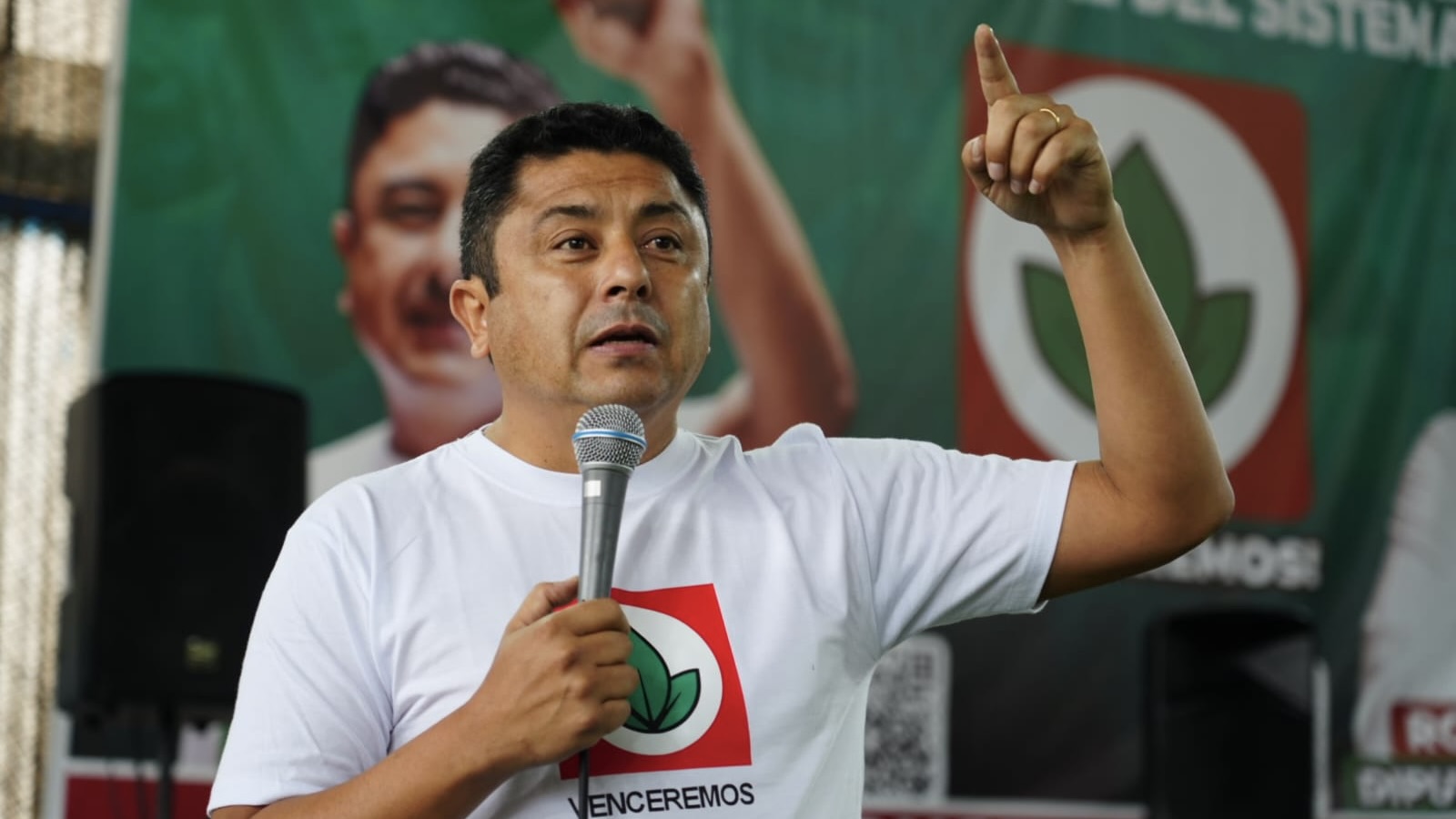
Guillermo Bermejo in a meeting in a popular neighborhood in Lima, Peru. Photo: Guillermo Bermejo / X
Lee en español aquí
On October 24, Peru’s judiciary sentenced leftist congressman Guillermo Bermejo to 15 years in prison for allegedly having ties to the Shining Path (officially the Communist Party of Peru) leaders in 2008 and 2009 in the areas of Apurímac, Ene, Mantaro, and Valle de Los Ríos. The crime, according to the Third Superior Criminal Court, is that of terrorist affiliation or membership.
The judicial authorities based their decision on a series of statements in which several witnesses allegedly affirmed that Bermejo attended coordination and political training meetings in Ayacucho. According to the court, there are photos and videos that would prove Bermejo’s alleged links to Shining Path militants.
For his part, Bermejo’s lawyer told the press that the conviction amounted to political persecution and he rejected the accusations: “They are talking about a case that occurred in 2008 and 2009, but they only opened an investigation in 2015; and after 10 more years, it is said that Bermejo may have met with people who may have been linked to Shining Path… No meeting is the subject of an indictment… [Guillermo Bermejo] is a victim of political persecution.”
Rejection of the court decision
Although the decision has been welcomed by several members of Congress and the country’s main media outlets, a significant sector of the left has strongly questioned the court’s decision. According to them, the ruling is part of a ploy to prevent Bermejo from participating in the upcoming 2026 presidential elections.
Sociologist Lucía Alvites affirms: “The judiciary has just sentenced Guillermo Bermejo to 15 years in prison. This is nothing more than early fraud. The right wing intends to remove anyone who opposes the model from the electoral race. Fascism is advancing; we cannot remain silent. Total solidarity with Guillermo Bermejo.”
For its part, the National Confederation of Agricultural Producers of the Coca-Growing Regions of Peru said in a statement: “We want to denounce to the international community that these legal actions are in response to a demand by those in power who seek to eliminate political competition in the upcoming 2026 elections.”
In the same vein, leftist congressman Guido Bellido sent words of support to Bermejo: “Our deepest support goes out to Guillermo Bermejo. May you find strength in this tough, unfair, and unequal fight you’re facing.”
Fair conviction or maneuver to prevent a presidential run?
According to an IPSOS poll conducted in August 2025, former presidential candidate Verónika Mendoza, a center-left politician, is the most popular figure ahead of the elections. However, Mendoza announced that she has no intention of running for president.
After Mendoza, Bermejo, who entered Congress under the auspices of the Peru Libre party, would be, according to IPSOS, the pre-candidate with the most popular support in the upcoming elections. With this court decision, the left loses one of its most important figures ahead of the 2026 presidential elections.
The progressive camp already knows what it is like to win a presidential election, having secured the presidency in 2021 with Pedro Castillo. In 2022, Castillo was deposed, imprisoned, and replaced by Dina Boluarte, his vice president and chief architect of the crackdown on demonstrations against what protesters called “a coup d’état,” which resulted in the deaths of nearly 60 demonstrators and multiple allegations of human rights violations.
Read More: Peru after the soft coup
The stigma of being a “terruco”
In Peru, “terruco” is an adjective commonly used to refer to a person as a “terrorist.” But the label “terrorist” in Peru evokes a painful and conflictive popular memory tied to the internal armed conflict in Peru in the 1980s and mid-1990s.
During those years, Peru was plunged into an internal war between the Shining Path and the Tupac Amaru Revolutionary Movement (MRTA) organizations and the state security forces. Those who fought against the army and the police were quickly labeled “terrucos”, and official history soon referred to this period as “the era of terrorism” due to the serious human rights violations committed against fighters and civilians on all fronts and by all military forces involved.
In this regard, the association denounced by the Peruvian justice system between the remnants of what was once Shining Path and Guillermo Bermejo seeks not only to disqualify him politically (as the sentence revokes his political rights for two years), but also to undermine the popularity of a figure who was beginning to emerge as an electoral alternative to Peru’s traditional political groups, which, after two presidential successions and dozens of street protests against the executive and legislative branches, do not seem to be able to find a strong candidate.
Read More: Peru’s latest president José Jerí faces mounting pressure after killing of protester
For now, Bermejo has been removed from his seat in Congress and is being held in prison while his defense team files the corresponding legal appeals to try to secure his release.