Amid mass protests in the West, Israel’s military footprint expands in Eastern Europe
Since the beginning of the genocide in Gaza, Israel has been expanding its military footprint in Eastern Europe, securing billions in contracts.
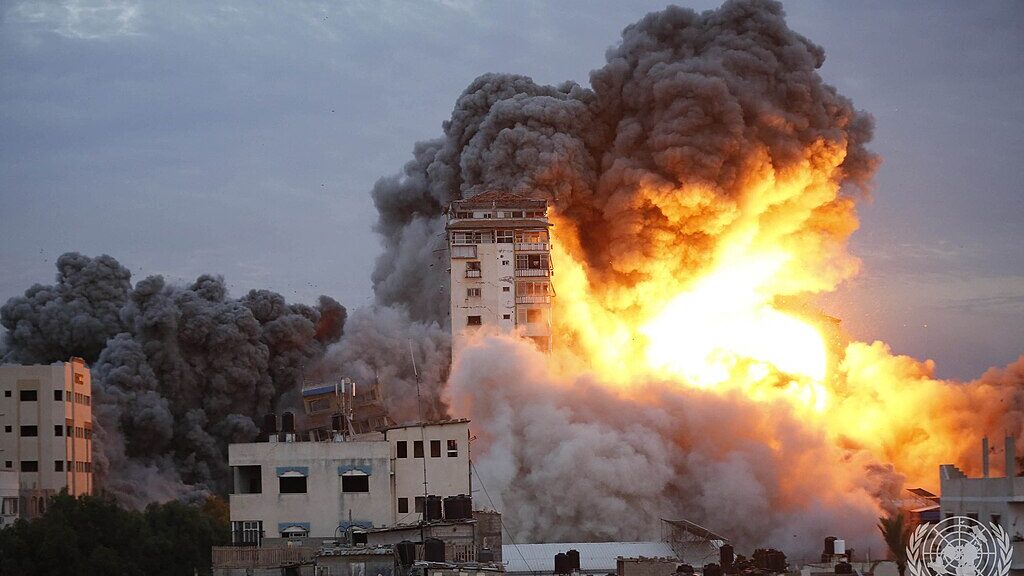
Continued Israeli airstrike of the Gaza Strip. © 2023 UNRWA Photo by Ashraf Amra/Wikimedia Commons
In the last two years, since Israel started its genocide in Gaza, the demands of the Boycott, Divestment and Sanctions (BDS) movement have moved into the mainstream in most Western European countries. Not just individual consumer boycotts but also calls for state-level sanctions, including a full military embargo, have become the main demands of the millions of Europeans taking to the streets against the genocide, occupation and apartheid in Palestine.
Actual gains have until now been meager and most European governments refuse to cut ties with the Israeli military industry. But there has been a visible shift at least at a discursive level, and more and more countries are at least curtailing military exports to Israel.
Despite minor changes in overall military exports, Europe remains the largest purchaser of Israeli military goods, accounting for 54% of total exports in 2024, the year in which Israel’s military industry saw a record breaking €12.86 billion in sales. While Spain has cancelled a deal worth €700 million for Israeli rocket launchers, this move remains an outlier, and European countries seem to be less willing to address the issue of Israeli military imports. This reluctance persists despite the findings of UN Special Rapporteur Francesca Albanese, whose “From Economy of Occupation to Economy of Genocide” report warns that not only states supplying weapons to Israel but also those purchasing them may be in breach of their obligations under international law, including the duty to prevent genocide.
Read more: Polish TNT powers bombs dropped on Gaza, report finds
The future of military trade between Western European states remains open, with some states pushing for a return to business as usual now that the so-called “Trump peace plan” has been at least partially implemented. There is, however, a growing resistance towards this move from the streets and the unions, which recognize that the genocide has never really ended and that Israel needs to be held accountable for its crimes. A military embargo is a first step towards this accountability.
In this context, Eastern Europe and the Balkans seem to gain an increasingly important role in Israel’s military trade strategy and, by extension, in its broader international political strategy, which are intertwined. The region is a more stable market, free from the potential disruption of large scale protests, transport disruption, and factory blockades as well as sabotage. This growing importance is reflected by the recent multi-billion deals that have been signed in the last couple of years with the Israeli military industry, discussed below.
While the reasons for turning to Israel vary across Eastern European and Balkan states, the major enabling factor is represented by the European rearmament drive and the ongoing war in Ukraine. Local specificities and historical ties play an important role, as do Romania’s longstanding ties with the founding family of Elbit Systems, Israel’s largest private weapon manufacturer. However, without the overarching historical context of accelerated EU rearmament, the extent of the cooperation would have never reached such magnitude.
Israeli military trade and economic expansion
Israel’s economy is geared towards continuous war. Israel’s war on Gaza is not only a military campaign, but also a profit event for a deeply financialized, export-driven arms industry. The structure of this industry requires continuous conflict to sustain growth, and Gaza and the West Bank have functioned as the central engine of this cycle. The genocide provided Israeli arms firms and the state with a “combat-tested” marketing narrative that fortified investor confidence, expanded markets, and enabled higher valuations for key companies in the sector.
The wave of European rearmament has opened precisely the kind of market expansion such an economy requires. The security panic across Europe has created unprecedented demand for air-defense systems, drones, artillery, intelligence platforms and border-security technologies.
Israeli firms, equipped with “combat-tested” products used in Gaza, have positioned themselves as rapid and relatively low-cost suppliers in a market where Eastern European and Balkan states are forced to choose between the more expensive Western (and sometimes South Korean) technology and the cheaper Israeli offer. This was the case of Romania’s €2 billion Rafael SPYDER deal, which was reported to be much cheaper than the counter offers made by Diehl Defense (Germany) with its IRIS-T system and by MBDA (France) with its VL Mica and Mistral 3 systems.
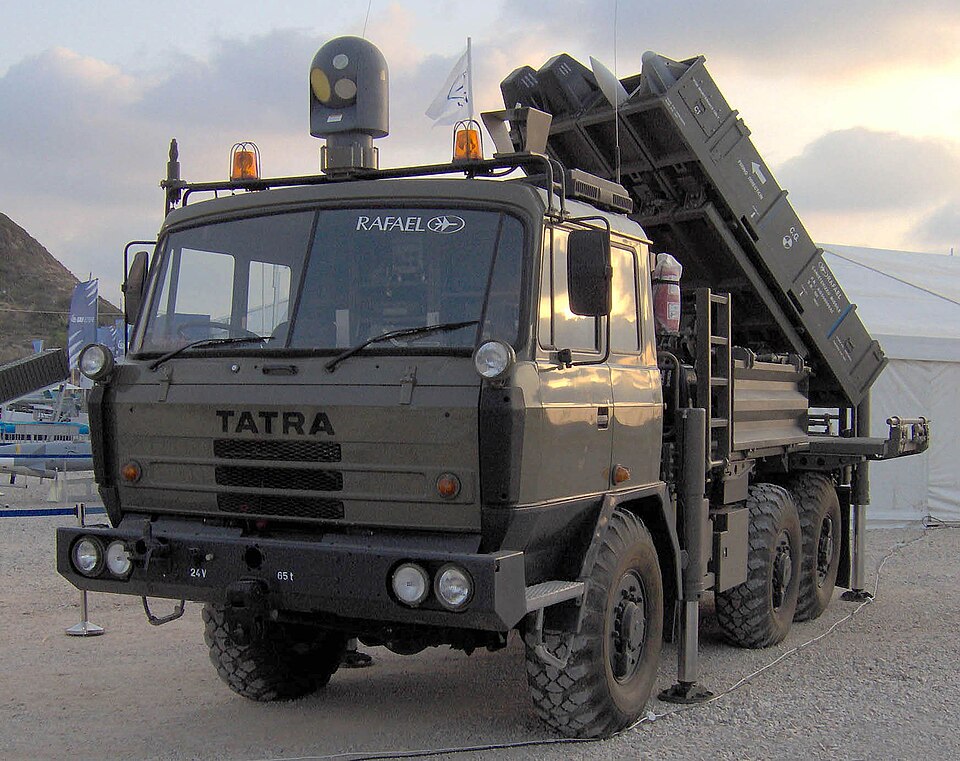 Rafael’s SPYDER air defense missile system. Photo: Wikimedia Commons
As a result, the war on Gaza has coincided with a dramatic expansion of Israel’s presence in Eastern European and Balkan defense markets, where procurement urgency and political alignment have overridden concerns about human rights violations or complicity in ongoing atrocities. Coupled with the lack of an organized mass movement against the genocide, this has meant that the Israeli arms industry that fueled the genocide has found a fertile ground in the region. We are heading towards a future where we will be even more intertwined with Israel’s economy of genocide and apartheid.
Record deals for genocide enablers
The “Elbit Out!” report, authored by Palestine Solidarity Cluj-Napoca, highlights a series of trends that extend further than Romania. Two years after the start of the genocide in Gaza, the report shows that the Romanian state has not only failed to take any concrete measures to stop the war crimes committed against Palestinians, but has in fact strengthened its military ties with the Israeli state apparatus, currently under investigation for genocide. Moreover, in the broader context of Europe’s rearmament, the report argues that the Israeli military industry is poised to play an increasingly significant role on both the Romanian and the wider Eastern European market.
While Israel has been the biggest export market for Romanian weapons and military components, totaling around €75 million, these numbers pale in comparison to both the local production of Israeli subsidiaries and deals with Israeli arms companies.
Read more: Nationwide campaign against Elbit Systems launches in Romania
As highlighted by the same report, Romania ranks first in Europe in terms of share of Elbit subsidiaries’ revenues, with its subsidiaries (Elmet International, A-E Electronics and Simultec) achieving a turnover of €160.4 million in 2024, i.e. 31.6% of the European total. Elmet International is also the largest subsidiary at continental level, with revenues of €118.5 million.
In 2025, Rafael Advanced Defense Systems was selected by the Romanian Ministry of Defense, through CN Romtehnica S.A., and awarded a contract to supply a V/SHORAD (“Very Short and Short Range Air Defense”) system. Romania signed a framework agreement with Rafael on July 18 worth approximately €2 billion excluding VAT. Prior to this, in December 2024, the Romanian state bought 8 anti-drone systems from Elbit, worth about €52 million.
Similar deals have been reported in several other neighboring countries.
In August 2025, Serbia concluded a landmark €1.4 billion agreement with Elbit Systems, one of the largest Israeli arms contracts ever signed in the Balkans. Belgrade acquired advanced long-range precision artillery rockets, unmanned aerial systems, and a broad suite of intelligence, surveillance, electronic-warfare, and command-and-control capabilities. According to regional defense reports, the agreement was designed to replace aging platforms and to equip the Serbian Armed Forces with an integrated digital combat network built around Israeli ISR and C4ISR technologies.
In late 2025, Albania signed a major agreement under which Elbit Systems will supply Tirana with advanced artillery, mortar systems, and tactical drones while helping the country establish its own domestic defense industry. According to Haaretz, the deal, signed between the two governments in September, includes 155-mm ATMOS truck-mounted howitzers, 120-mm SPEAR mortar systems, and two families of short-range drones, the Magni-X and Thor, one of Albania’s most ambitious military procurements to date. Beyond weapons delivery, the agreement commits Elbit to supporting Albania’s efforts to build production capacity through cooperation with KAYO, the state-owned defense company founded in 2024, which is developing a 5,000-square-meter manufacturing facility in northern Albania.
Read more: Militarization in Italy: from the war economy to the battle of ideas
In November 2025, Moldova quietly introduced Eblit’s ATMOS 2000 155 mm truck-mounted howitzers into its arsenal. The Moldovan Ministry of Defense has released footage of live-fire exercises confirming that the ATMOS systems, recently delivered from Israel, are already operational and embedded in national service. Until this reveal, the acquisition had remained outside of the public eye, without any information on its costs or timeline.
In December 2024, Israel and Slovakia concluded an agreement under which Israel Aerospace Industries (IAI) would supply Slovakia with the Barak MX air-defense system in a contract valued at approximately €560 million. The deal was described by Israel’s Ministry of Defense as the largest defense deal ever between the two countries, and marks a major step in Slovakia’s efforts to modernize its air-defense capabilities and to replace its ageing Soviet-era systems. Under the agreement, Slovakia is to receive six batteries of the Barak MX system. The contract also includes training, technical support, simulators, spare parts and provisions for local participation in component manufacture.
Greece is currently preparing a major €3.5 billion modernization of its national air-defense network under the “Achilles’ Shield” program. Reported on November 11, 2025, the program aims to replace outdated Russian and US systems with an integrated, multi-layered network sourced primarily from Israel Aerospace Industries (IAI) and Rafael Advanced Defense Systems.
Taken together, these contracts reveal a coherent pattern: Israel is securing long-term footholds across Eastern Europe by selling integrated systems artillery, air defense, drones, and ISR/C4ISR infrastructures. These lock states into Israeli supply chains for decades.
Complicity in the genocide economy and structural vulnerability
The growing military cooperation between Eastern European and Balkan states and Israel must be understood not only as a matter of procurement policy but as direct complicity in what Francesca Albanese has described as Israel’s “economy of genocide.” By purchasing weapons from a state currently under investigation for the crime of genocide, and by relying on its military-industrial ecosystem to restructure national defense sectors, governments are inserting themselves into a supply chain whose operational logic is inseparable from the destruction of Gaza and the ongoing dispossession of Palestinians. It binds our states to a war machine whose profitability depends on continuous violence and on consistent violations of and contempt for international law.
This entanglement is not merely ethical or political – it also has concrete operational consequences for European procurement, as Israel is currently facing a significant production backlog caused by the war on Gaza. As Israeli companies reorient production lines to supply the IDF first, export orders to Europe are frequently postponed, renegotiated, or scaled back. Romania has already experienced delays and uncertainty in deliveries and servicing for certain systems during the Gaza assault, illustrating how easily European militaries can become hostage to bottlenecks in Israel during intensified military operations. Elbit’s backlog had reached €19.6 billion by the end of 2024. While the company and its investors are praising this record as a testament to the company’s prestige, questions remain about its capacity to fulfill orders, especially considering the situation in the region.
Manufacturing consent: high-tech killing
The main argument we often hear along with the “combat-tested” label is Israel’s high tech military capabilities: everyone has heard by now of the “impenetrable” Iron Dome. Ionut Mosteanu, Romania’s Defense Minister, boasted upon the signing of the €2 billion Rafael deal that Romania has acquired the Iron Dome. This is not the case, as pointed out by various military analysts. The SPYDER V/SHORAD is not part of the Iron Dome architecture and doesn’t even benefit from combat experience. In this instance, Israel’s reputation has preceded it. It is the kind of statement that facilitates public acceptance of a €2 billion purchase. Yet the story of the Israeli military tech giant is nothing but a paper tiger when tested against reality.
Recent events in Israel further demonstrate that even the most sophisticated defense architectures cannot guarantee complete protection. Israel’s air-defense network, often presented as the most advanced multilayered system in the world, was severely stress-tested during Iran’s large-scale strike of April 2024. Despite support from the United States, France, the United Kingdom, and Jordan, and despite Israel’s deployment of Iron Dome, David’s Sling and Arrow interceptors, the defensive shield was not airtight. Israeli authorities acknowledged that several Iranian ballistic missiles penetrated the system and struck the Nevatim and Ramon air bases, causing structural damage and briefly disrupting operations. Missiles also hit the center of Tel Aviv.
For offensive technology the picture gets even grimmer. Taking a closer look at the mechanisms behind the Israeli industry, we will see that Israel’s defense industry is not driven primarily by technological innovation but by its ability to disregard the rules of war in pursuit of what Israel calls the Dahiya doctrine. Its military-industrial complex relies heavily on US funding, battlefield testing on Palestinians, and the rapid scaling of tools designed for population control, intelligence extraction, and punitive bombardment. The military sophistication of these tools is often overstated.
The brutal, high-destruction attacks witnessed in Gaza and Lebanon in recent years have been neither technologically advanced nor strategically complex. They reveal a military doctrine oriented toward overwhelming force rather than precision, and an industry that monetizes destruction rather than breakthroughs. There are serious questions to be raised as to how this technology could be useful in the European context.
Eastern European states purchasing from this system are therefore not acquiring a future-proof, autonomous military capability. They are importing dependence on US-Israeli geopolitics, on volatile wartime supply chains, and on an industry whose growth is inseparable from the ongoing annihilation of a people. In embedding themselves into Israel’s militarized economy, our states not only become complicit in its crimes but also structurally exposed to the instabilities of a deeply financialized war machine. This double bind of complicity and vulnerability is the true cost of aligning with Israel’s military economy.
For peace, against complicity
At a time of rising living costs and collapsing public services, diverting billions into the coffers of companies arming an ongoing genocide is neither defensible nor sustainable. The promise of “military Keynesianism” is a mirage: it drains public resources, deepens dependency on foreign war economies, and offers no real security for our societies.
Eastern Europe must reject this accelerating logic of militarization. Aligning ourselves with the regional wars of Israel and the US, or with the broader European rearmament race, only entrenches our economic vulnerability and political subordination. Instead, we need a regional agenda centered on peace, democratic accountability, and human security. This moment in history can be a catalyzer for the disparate movements in the region to work together and build around this agenda.
A clear demand emerges from this moment: an immediate military embargo on Israel and a collective refusal to subordinate our societies to the interests of transnational arms corporations. This is the first step toward breaking our complicity, reclaiming public resources, and building a future grounded not in war-making, but in peace and justice.
Vlad Mureşan is a member of the Palestine Solidarity Cluj-Napoca collective and coordinator of the Elbit Out! Campaign in Romania.