China warns that growing Japanese militarization threatens world peace
The Chinese UN representative wrote a letter to the UN secretary general reiterating the demand that the Japanese prime minister retract her “erroneous statement” on Taiwan made last month.
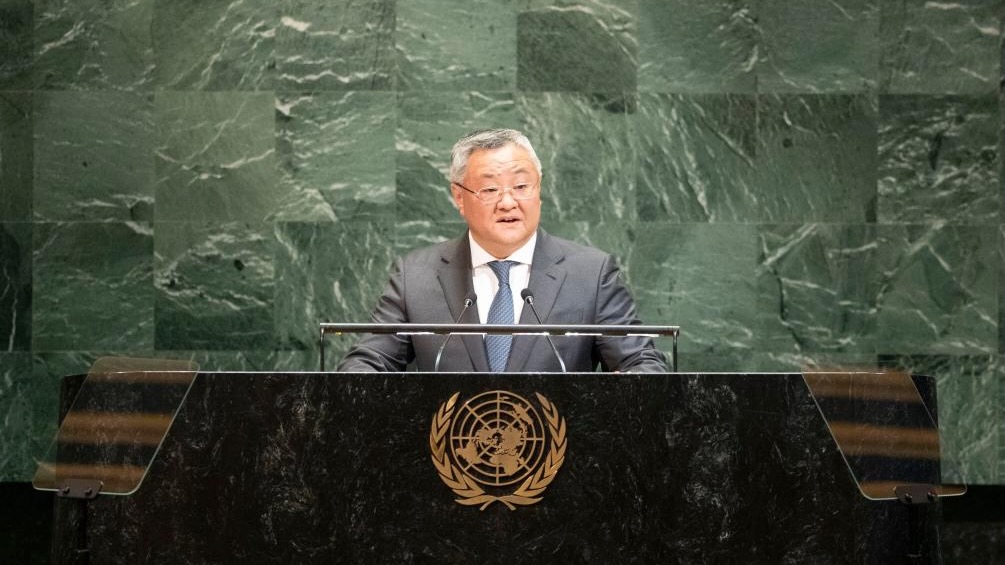
Fu Cong, China's permanent representative to the United Nations, speaks at the UN General Assembly. Photo: Xinhua
In a letter to UN Secretary-General António Guterres on Monday, December 1, China’s permanent representative to the UN, Fu Cong, warned against Japan’s growing attempts to rearm, calling it a threat to world peace and the postwar international order.
“In light of Takaichi’s dangerous remarks, the international community must remain highly vigilant against Japan’s ambitions to expand its military capabilities and revive militarism, and jointly safeguard world peace,” Fu warned in his letter.
Fu was referring to the statement made by Japanese Prime Minister Sanae Takaichi last month, in which she claimed any military action in Taiwan would constitute an “existential crisis” for her country and invite its own military intervention.
China-Japan relations have taken a hit since the statement was made, as China sees it as a direct threat to its national integration. However, despite the diplomatic row over her statement and Chinese backlash, Takaichi has refused to retract it, merely claiming she will not repeat it in future.
Fu reiterated the Chinese position, calling Takaichi’s statement an erroneous one that “openly challenges the victorious outcomes of World War II and the post war international order, and constitutes a serious violation of purposes and principles” of the UN Charter.
Japan officially adheres to the “one-China” policy. However, it now has joined the US in framing the issue as the possible forced integration of Taiwan with the mainland. China calls it an intervention in its domestic matters.
Fu’s letter was in response to a letter to the secretary-general on November 24 by the Japanese representative to the UN, Kazuyuki Yamazaki, which tried to dismiss the Chinese concerns over Takaichi’s statement that Fu had himself outlined in an initial UN letter after the comments were made.
Yamazaki claimed Japan has not changed its position on Taiwan since 1972 and expressed hope that the issue would be resolved diplomatically, refusing to respond to the Chinese demand of an immediate retraction of Takaichi’s statement.
Japan’s dubious position
Fu demanded an explanation of Japan’s claims of a “consistent position” on Taiwan, arguing that it has always evaded the question in violation of its commitments under the postwar arrangements which confirmed Chinese sovereignty over the island.
Fu reminded that various international legal instruments, such as the Cairo declaration of 1943, the Potsdam proclamation of 1946, and the Japanese instrument of surrender, among others, have confirmed Chinese sovereignty over Taiwan. They also established the principles for post-war arrangements concerning Japan.
In addition, in the 1972 Sino-Japanese joint statement, Japan explicitly recognized Chinese sovereignty over Taiwan, along with several treaties and documents signed between the two states since then.
Fu also questioned the claims made by Yamazaki that Japan has a “passive defensive strategy”, saying that talking about a Chinese territory while discussing defense strategies does not amount to a “passive defensive strategy” and such arguments are “self-contradictory and are intended to mislead the international community.”
In a reply to a question on Japan’s reluctance to clarify its position on Taiwan on Monday, Lin Jian, spokesperson of the Chinese Ministry of Foreign Affairs accused that Japan is deliberately maintaining a vague and confused position on the issue which is a “blatant challenge to the authority of the UN and the postwar international order.”
A threat to postwar order
Fu warned the world of Japan’s desire to “break free” from a defense-oriented outlook and its transformation to an aggressive military power through rearmament. He claimed that this is a reflection of Japan’s refusal to revisit and reflect on its past colonial atrocities.
China highlighted the Japanese right wing’s attempts to “whitewash its history of aggression” and revise its security policies. It claims that contrary to the arrangements made after the Second World War, Japan has started producing and exporting lethal weapons already and there is growing talk in the country of developing nuclear weapons as well.
Read More: Japan’s Taiwan hysteria reveals a dark imperial legacy
In this context, Fu asks, “with Takaichi’s erroneous remarks violating the commitments Japan made to date, how can it expect to win the trust of the international community?”
Lin too argued that the growing militarization of Japan is alarming for world peace, calling it a betrayal of its international obligations and demanded timely action to stop it.
Claiming that if Japan wants to normalize relations it “should clearly reaffirm the one-China principle, faithfully uphold the spirit of the four political documents [Cairo, Postdam, Japanese instrument of surrender and 1972 joint statement] between the two countries and its political commitments, immediately retract the erroneous remarks, and take practical steps to honor its commitments to China,” Fu demanded.